Arthur vs WitnessAI: A Detailed Feature Comparison for AI Governance and Agents
Enterprises adopting AI face the same question no matter where they start: how do you let people and systems use AI without losing visibility and control? Arthur and WitnessAI both answer that question, but they come at it from different ends of the problem. WitnessAI governs how employees and applications talk to AI models. Arthur is an AI control plane that unites the teams who govern AI with the teams who build it, spanning agent discovery and governance through agent development.
This comparison maps where the two platforms overlap, where they differ, and which fits which job. Both are credible choices, and for many organizations they solve adjacent problems rather than competing for the same one.
The short version
WitnessAI sits between users and the models they use, discovers shadow AI, classifies every prompt and response, and enforces policy in real time through a suite of guardrails.
Arthur is an AI control plane for governing and building AI, built for security, audit, governance, engineering, and product teams. At its center is Agent Security and Governance (ASG): discovering every agent across your cloud environments, assigning each an accountable owner and risk classification, and enforcing unified policy at the scale of thousands of agents. ASG is backed by an Agent Development Toolkit that runs on the Agent Development Lifecycle (ADLC): observability, prompt management, continuous and supervised evaluations, experiments, and guardrails. The result is one source of truth for the teams that govern AI and the teams that build it.
Feature comparison
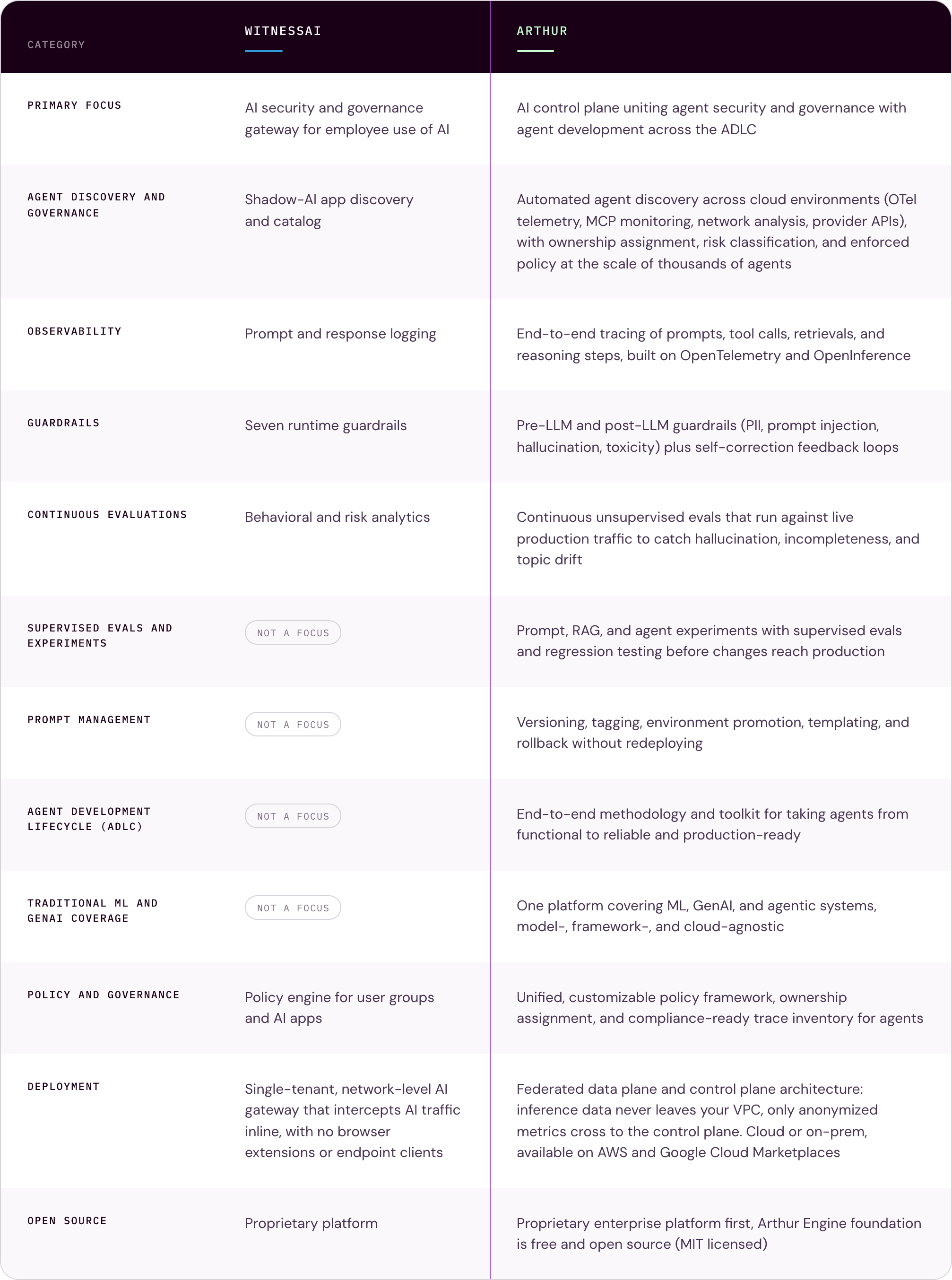
What WitnessAI focuses on
WitnessAI is an AI enablement platform: let people use AI, but see and control every interaction. It discovers AI in use and risk-scores each app, logs and classifies every prompt and response by intent and risk type, and enforces policy through a suite of runtime guardrails that map user groups to specific AI apps with allow or block actions. Its differentiators are intent-based classification, cross-conversation context, and shadow-AI discovery.
What Arthur focuses on
Arthur's Agent Security and Governance (ASG) brings every agent in the environment under one framework: discover, triage, onboard, and govern, at the scale of thousands of agents. Discovery is multilayered and automated, catching agents regardless of how they enter the enterprise: telemetry listeners on OpenTelemetry streams, MCP server monitoring, network-layer analysis for LLM API signatures, and API-driven discovery from cloud platforms like AWS Bedrock and Google Vertex AI. Once found, an agent gets an accountable owner, a risk classification, and enforced policy, so security, audit, and governance teams get one source of truth for what is running, who owns it, and how much risk it carries.
ASG is grounded in the reality that agentic AI behaves differently from traditional software. Getting an agent to a functional state is quick; making it reliable and governable is the hard part. The Agent Development Toolkit handles that work through the Agent Development Lifecycle (ADLC), treating reliability as a structured engineering discipline rather than guesswork.
The platform covers six practices that map to the lifecycle of building and running an agent:
- Observability and tracing. Every LLM call, tool invocation, retrieval, and decision point is traced end to end, built on OpenTelemetry with OpenInference semantic conventions.
- Prompt management. Prompts live outside application code with versioning, environment tagging, templating, and rollback, so teams iterate without redeploying.
- Continuous evaluations. Unsupervised evals run against live production traffic to catch hallucination, incompleteness, and topic drift before users report them.
- Experiments and supervised evals. Teams test prompt, RAG, and model changes against real data and use the same datasets as regression suites.
- Guardrails. Pre-LLM checks protect what goes into the model (PII, prompt injection); post-LLM checks control what comes out (hallucination, toxicity), including self-correction loops that revise a response mid-execution.
- Discovery and governance. Arthur discovers agents across environments, inventories their tools, subagents, models, and data sources, and applies a unified policy framework with clear ownership so agents can clear enterprise compliance reviews.
Arthur deploys as SaaS, hybrid, or on-prem, with the data plane running inside your VPC so telemetry never leaves your environment. It is model-, framework-, and cloud-agnostic, and covers ML, GenAI, and agentic systems on one platform. The Arthur Engine, its evaluation and monitoring foundation, is free and open source.
Where they overlap
Both platforms discover AI that teams did not manually register, both apply guardrails at runtime, both classify intent and behavior rather than relying on simple keyword matching, and both frame governance as a continuous, telemetry-driven activity. If you only read the guardrail and discovery pages, the two products look adjacent.
Where they differ
The core difference is what each platform governs. WitnessAI governs the traffic between people and models: employees and applications sending prompts to AI, with the emphasis on security posture, data protection, and acceptable-use enforcement across a workforce. Arthur governs the agents an organization builds and runs: discovering them, assigning ownership and risk, and giving builders the tracing, evaluations, and experiments that make an agent reliable enough to ship.
Three practical distinctions follow:
- Scope of governance. WitnessAI's control point is the network gateway between users and third-party AI. Arthur's control point is the agent itself, wherever it runs, through automated discovery, ownership assignment, risk classification, and unified policy across thousands of agents.
- Builder tooling. Arthur pairs governance with an Agent Development Toolkit: prompt management, prompt/RAG/agent experiments, supervised and unsupervised evals, and end-to-end tracing. This is the tooling teams use to take an agent from functional to production-ready.
- Deployment and openness. WitnessAI is a single-tenant, network-level gateway that inspects AI traffic inline without browser extensions or endpoint clients. Arthur uses a federated data plane and control plane architecture, so inference data stays in your VPC while only anonymized metrics reach the control plane. Arthur is a proprietary enterprise platform first, with the Arthur Engine as its free, open-source evaluation platform that any builder can use.
How the two map to different problems
The two platforms line up against different problems, so the clearest way to compare them is by the work each is built to do.
WitnessAI is built for employee and application use of third-party AI. Its strengths show up when the problem is discovering shadow AI, logging and classifying every interaction, preventing data leakage, and enforcing acceptable-use policy across a workforce.
Arthur is built for the agents an organization develops and runs. Its strengths show up when the problem is making an agent reliable and governable: tracing to see what the agent did, evaluations to catch regressions, experiments to test changes safely, and agent discovery and governance to clear enterprise compliance reviews.
The two are often complementary rather than mutually exclusive. A security gateway can govern how people use external AI while an agent platform governs the agents the organization builds and ships. Mapping your own problem to these categories is the fastest way to see where each fits.
Interested in building production-ready agents? Book a demo with an AI expert or explore the open-source Arthur Engine to get started.
SHARE


