Evaluating AI Agents in Production: Best Practices
Evaluating AI agents in production requires continuous, automated evaluation of both the agent's final outputs and its full execution path, backed by observability, guardrails, and human review. Pre-deployment test suites are not enough. Agents are non-deterministic, multi-step, and tool-using, and the range of inputs they see in production is far more diverse than any handwritten test set can cover.
Most teams find out their agent is misbehaving the same way: a user files a complaint. By then the damage is done. The practices below shift that dynamic, so you get automated signal the moment something goes wrong instead of waiting for a bug report.
This guide distills lessons from Arthur's Forward Deployed Engineering team, based on real-world deployments of production agents across industries. It stands on its own as a practical reference, and links out to deeper dives where useful.
Why Evaluating AI Agents in Production Is Different
Evaluating AI agents in production is different because agents reason, plan, and act autonomously across multiple steps, tools, and data sources, which means failures are often silent and hard to reproduce.
A few properties make production evaluation its own discipline:
- Non-determinism. An agent that passes a test suite today can fail the same cases tomorrow. Unit tests help, but they cannot guarantee consistent behavior on their own.
- Silent failures. Agents are confidently wrong. They generate a fluent response based on whatever context they received, even when that context was incomplete or retrieved the wrong documents.
- Diverse production traffic. The domain of real inputs is far broader than any test set a team writes by hand.
- System-level behavior. You are not just evaluating a model. You are evaluating prompts, tool selection, RAG retrieval, and orchestration logic working together.
This is the core reason the Agent Development Lifecycle (ADLC) treats agent improvement as a continuous, measured process rather than a one-shot build. Getting an agent to functionally complete is fast. Getting it to reliable is where the work lives, and production evaluation is the control system that makes that work possible.
Start With Observability and Tracing
You cannot evaluate what you cannot see. Observability and tracing are the foundation of production evaluation, because every eval, alert, and improvement depends on having a complete record of what the agent actually did.
End-to-end tracing lets you follow an agent execution from the first user message through every reasoning step, tool call, and retrieval, even as it crosses services and APIs. That trajectory-level visibility is what lets you evaluate not just the final answer but the path the agent took to get there.
At minimum, instrument these five areas:
- LLM calls: full prompts, completions, model configuration, token counts, and cost.
- Tool invocations: inputs, outputs, and latency for every API call, database query, or code execution.
- RAG retrieval: which documents were pulled, and just as importantly, which were not.
- Application metadata: user IDs, session IDs, and domain identifiers that connect behavior back to real user experiences.
- Key decision points: the context that drives how the agent reasons and acts.
The industry is coalescing around OpenTelemetry as the vendor-neutral standard for agent telemetry. Within it, the OpenInference semantic conventions offer richer detail for production agents than the OTEL GenAI conventions: first-class spans for LLM, tool, retriever, and agent steps, plus out-of-the-box auto-instrumentation for frameworks like LangChain, LlamaIndex, and OpenAI. Emitting traces to a standard, centralized location also makes your agent discoverable and governable later.
Supervised vs. Unsupervised Evals: Which One Runs in Production
The single most important distinction in agent evaluation is supervised versus unsupervised evals, because it determines what can actually run continuously in production.
- Supervised evals require knowing the correct answer ahead of time: the expected response, the tool that should have been called, or the expected retrieval result. They are valuable for offline regression testing against a labeled dataset, but they cannot run continuously in production, where inputs and outputs change with every interaction.
- Unsupervised evals assess behavior using only the information available in the agent's own context. No ground-truth answer is required, so they can run against every production interaction.
Common unsupervised evals that run in production:
- Hallucination / groundedness: Did the agent state facts not supported by the context it had access to?
- Answer completeness: Did the agent address every part of the user's question?
- Topic adherence: Did the agent stay within the topics defined by its system prompt?
- Goal accuracy: Did the agent call the right tools to fulfill the user's intent?
Unsupervised evals power continuous production monitoring. Supervised evals power offline experiments and regression testing, covered later in this guide.
Best Practices for Continuous Evaluation in Production
Continuous evals are automated checks that run against your agent's real production interactions to detect behavioral issues before your users do. These practices make them reliable enough to trust.
Make evals binary, not scored on a range
Score each eval pass/fail rather than 1 to 10 or low/medium/high. Ranges push the judgment burden onto a human who has to decide what threshold matters, and LLM-based scorers are inconsistent across runs. When a binary eval fires, it should mean something genuinely requires attention. Require an explanation alongside the verdict so you can spot patterns across failures quickly.
Make each eval specific to one failure mode
A generic eval like "rate the quality of this response" produces noisy, inconsistent results. "Did the agent reference information not present in the retrieved documents?" is specific enough for an LLM to judge reliably. If you cannot describe what an eval checks in a single sentence, it is too broad.
Use LLM-as-a-judge with examples in the prompt
LLM-as-a-judge evals are strong at generalizing over content: tone, completeness, instruction adherence, and groundedness. Include both passing and failing examples in the eval prompt, focused on the edge cases and boundary decisions where the eval might otherwise be inconsistent. Examples calibrate the gray areas more effectively than longer instructions.
Choose the right model to balance accuracy and cost
Evals run on every production interaction, so cost and latency add up fast. Establish a quality baseline with a capable model, then test whether a smaller model matches it on the same interactions. If accuracy holds, you cut eval costs significantly without losing signal.
Use deterministic checks where they fit
LLM evals are weak at precise quantitative assessment. To verify a calculation, check a number against a range, or measure retrieval precision and recall, a deterministic check such as a function or schema validator is cheaper and more reliable. Reserve LLM-as-a-judge for generalizing over content.
Run evals continuously on real production traffic
Test suites cover known cases. Continuous evals running against live traffic catch the failure modes that only emerge in production, the moment they appear.
Key Metrics for Evaluating AI Agents in Production
A complete evaluation strategy measures agent quality, behavior, operational health, and safety together. No single metric captures whether an agent is performing well.
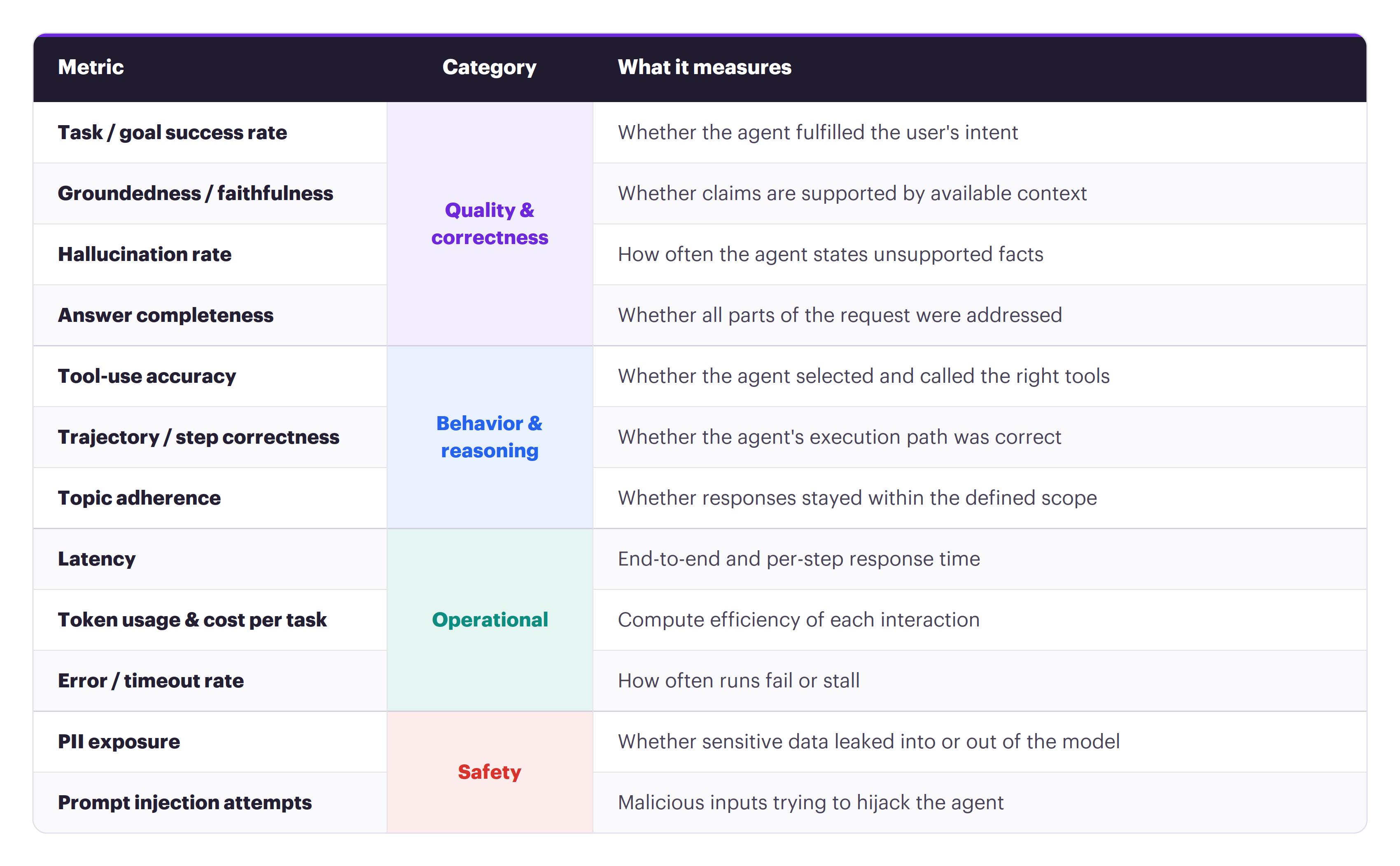
Quality and behavior metrics are best assessed with unsupervised LLM-as-a-judge evals. Operational metrics come directly from your traces. Safety metrics are typically enforced with guardrails, covered next.
Guardrails: Evaluation That Acts in Real Time
Evals detect problems after the fact across production traffic. Guardrails are different. They intercept agent behavior in real time, before a bad input reaches your LLM or a bad output reaches your user.
Pre-LLM guardrails run before the user's input and assembled context reach the model:
- PII detection and redaction so sensitive data never leaves your environment for an external provider.
- Sensitive data blocking for credentials, payment details, or proprietary information.
- Prompt injection detection to catch inputs designed to override the system prompt.
Keep pre-LLM guardrails fast and deterministic. They run in the hot path before every call, so regex-based PII detection and rule-based injection checks are preferable to LLM-based ones here.
Post-LLM guardrails run after the model responds, before that response reaches the user:
- Hallucination detection against the context the agent had access to.
- Toxicity detection for harmful or inappropriate content.
- Tool and action validation to confirm the agent did the right thing.
- Output format compliance before a response is passed downstream.
The most powerful post-LLM pattern is a self-correction loop. When a guardrail flags an unsupported claim, instead of surfacing a failure, the system feeds the issue back to the LLM with a targeted correction prompt: here is what you said, here is what was unsupported, revise it. The agent retries and the corrected output runs through the guardrail again, until it passes or hits a retry limit. The user only ever sees a grounded response, with no manual review required.
Responding to Eval Failures: Alerting and Human-in-the-Loop Review
Once continuous evals are running, you need a plan for what to do when they fire. In practice there are two patterns, chosen by eval confidence and system maturity.
- Real-time alerting. Teams with high-confidence, low-false-positive evals wire up alerts on failures. When an eval triggers, the team is notified immediately and can investigate before more users are affected.
- Human-in-the-loop review. Earlier-stage teams use eval failures as a triage mechanism. Failures queue interactions for human review, and the team analyzes clusters of failures to find common patterns and prioritize fixes.
Both patterns close the same loop: production failures become datasets, and those datasets become regression tests that ensure the same issue never silently reappears.
From Detection to Improvement: Experiments and Regression Testing
Continuous evals tell you what is failing. They do not tell you what to change. Experiments close that gap by testing changes in isolation against a fixed dataset and supervised evals, so you can measure impact before anything ships.
An experiment combines three things: a dataset of known inputs and expected outputs, supervised evals to score against that ground truth, and a single variable to test such as a new prompt version, a retrieval config, or a model swap. Run experiments at the right level of isolation:
- Prompt experiments run a prompt against a dataset without spinning up the full agent. The fastest iteration loop.
- RAG experiments verify that retrieval returns the right context for known queries, catching one of the most common root causes of agent failures.
- Agent experiments run the full agent end to end and evaluate both the final output and the intermediate trajectory.
Start narrow, iterate at the prompt or RAG level, then validate end to end before promoting. Build your datasets from real production failures surfaced by continuous evals, and that same dataset doubles as a regression suite: re-run it before every deployment to make sure new changes do not break previously fixed behavior.
A Practical Checklist for Evaluating AI Agents in Production
Use this checklist to evaluate AI agents in production end to end:
- Instrument tracing from day one with OpenTelemetry and OpenInference conventions
- Trace LLM calls, tool invocations, RAG retrieval, metadata, and key decision points
- Define binary, specific, unsupervised evals for hallucination, completeness, topic adherence, and goal accuracy
- Provide pass/fail examples in eval prompts to calibrate edge cases
- Run evals continuously against real production traffic, not just at release
- Track quality, behavior, operational, and safety metrics together
- Add pre-LLM guardrails for PII, sensitive data, and prompt injection
- Add post-LLM guardrails for hallucination, with a self-correction loop
- Alert on high-confidence failures, or queue lower-confidence ones for human review
- Feed production failures back into experiments and regression tests
Conclusion
Evaluating AI agents in production comes down to one connected loop: observability gives you the traces, continuous evals surface failures from those traces, guardrails intercept problems in real time, and experiments turn failures into durable improvements. Each layer depends on the one before it, and together they replace guesswork and vibe checks with measurable reliability.
The teams that ship agents with confidence are the ones that build this loop early. The ones that wait are stuck reacting to user complaints.
Start using the Arthur Engine to play with evals today. The Arthur Engine is a free, open-source platform for evaluation and monitoring, with continuous evals, tracing, and real-time guardrails you can get hands-on with immediately. For deeper dives on each stage, explore the Best Practices for Building Agents series.
SHARE


