Risk Tiering for AI Agents: Match Controls to Risk
Most teams govern every agent the same way. A meeting-notes summarizer gets the same review as an agent that moves money, or more often, the money-moving agent gets no more scrutiny than the summarizer. Both outcomes are wrong. Uniform governance over-controls the harmless agents, wastes effort, and leaves the dangerous ones under-watched.
Risk classification fixes that. You rank each agent by the risk it actually carries, then match the depth of your controls to that rank. High-risk agents get approval gates, deep logging, and frequent evaluation. Low-risk agents get a light touch. This post is a practical how-to for building that tiering system and keeping it accurate as your agents change.
Why risk tiering matters for agents
Controls are not free. Every approval gate adds latency, every eval adds cost, every review consumes a person's time. Spend that budget evenly across all agents and you pay a high price to over-govern the agents that could never cause harm, while the agents that can delete records or send customer communications get the same thin oversight as everything else.
Risk-based control is also what governance frameworks and regulators expect. They do not ask you to apply maximum controls everywhere. They ask you to apply controls proportional to risk, and to be able to explain why each agent sits where it does. Tiering is how you make that explainable: a defensible reason for the control depth on every agent.
The dimensions that determine an agent's risk
An agent's risk is not one number. Score it across several dimensions, then combine them into a tier.
Autonomy. Does the agent suggest actions for a human to approve, or does it act on its own? An agent that drafts a reply for review is lower risk than one that sends it. Full autonomy raises the tier.
Blast radius and reversibility. What is the worst thing this agent can do, and can it be undone? A read-only agent that answers questions has a small blast radius. An agent that moves money, deletes data, or sends external communications can cause irreversible harm. Irreversibility raises the tier sharply.
Data sensitivity. What data does the agent touch? PII, financial records, health data, and proprietary information all raise risk. An agent that only reads public product docs is lower risk than one with access to customer accounts.
Tool and system access. Which tools and APIs can the agent call, and does it have write access? An agent bound to one read-only search tool is far lower risk than one with write access to a production database or a payments API.
Domain. Is the agent operating in a regulated or consequential domain (credit, employment, healthcare, benefits) or an internal convenience task? Consequential domains raise the tier regardless of how well the agent performs.
Reach. Is the agent internal-only or customer-facing? Customer-facing agents carry brand, legal, and trust exposure that internal tools do not.
A simple three-tier model
You do not need ten tiers. Three is enough for most organizations, and fewer tiers are easier to enforce consistently.
Tier 1 (critical). High autonomy, large or irreversible blast radius, sensitive data, or a regulated domain. Example: an agent that approves refunds, moves funds, or makes eligibility decisions. These carry the deepest controls.
Tier 2 (moderate). Meaningful action or data access, but with limited blast radius or a human in the loop. Example: a support agent that reads customer tickets and drafts replies but cannot issue refunds or change accounts.
Tier 3 (low). Read-only, internal, non-sensitive, no consequential downstream effect. Example: an agent that summarizes meeting notes or triages internal tickets. These carry the lightest controls.
When an agent spans more than one description, classify it by its highest-risk function. An agent that summarizes notes (Tier 3) but can also send external emails (Tier 1) is a Tier 1 agent.
Matching controls to tiers
The point of tiering is to decide control depth. Map each tier to a set of controls so the decision is automatic once an agent is classified.
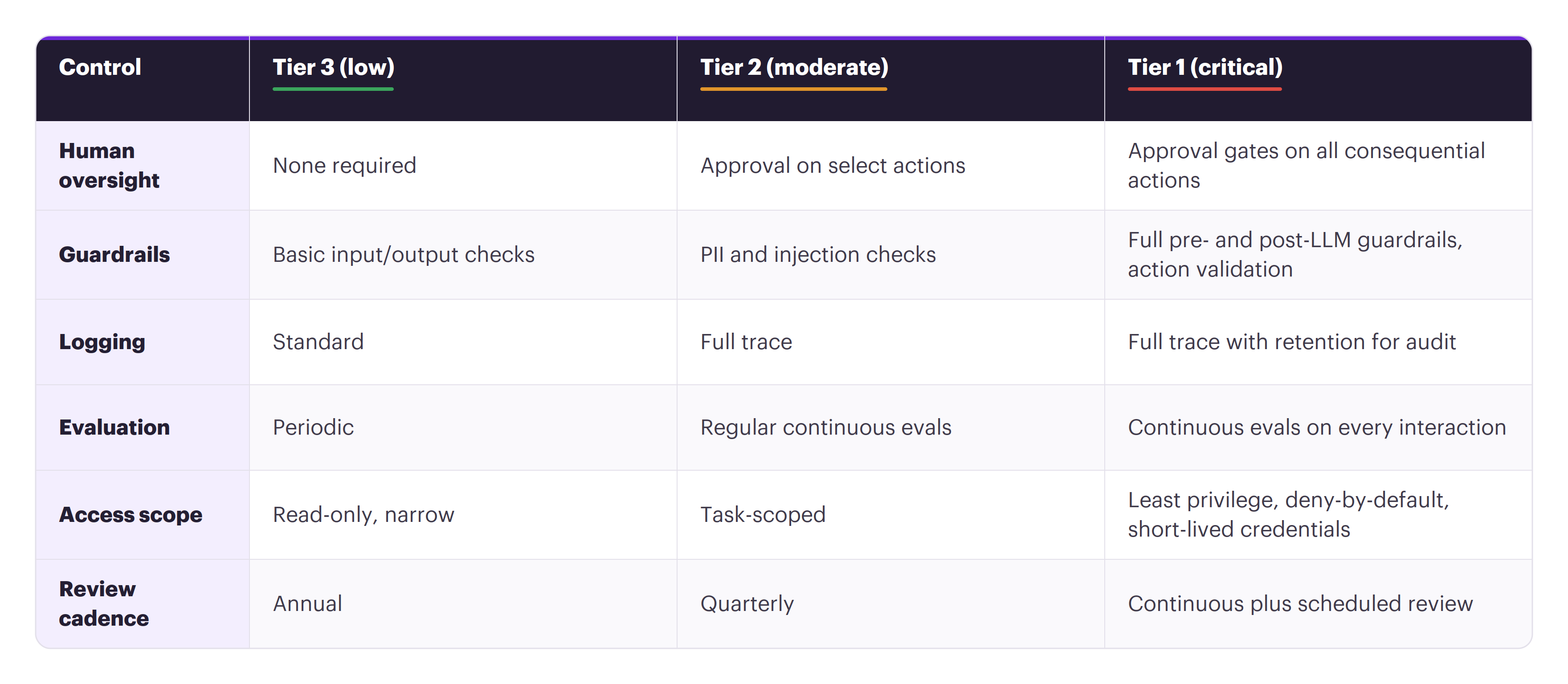
Adjust the specifics to your environment, but keep the principle: control depth rises with the tier, and every agent inherits the controls of its tier by default.
How to run classification at scale
Classification breaks in two common ways. First, you can't classify what you can't see. Agents spun up across teams and cloud environments, shadow agents that never went through review, are missing from the spreadsheet entirely, so they carry no tier and no controls. Any classification effort has to start from a complete inventory, which means automated discovery, not a manual census.
Second, classification drifts. An agent classified as Tier 3 when it only read documents becomes Tier 1 the day someone gives it a tool that writes to a database. If tiering is a one-time exercise recorded in a spreadsheet, that change goes unnoticed and the agent operates with controls built for a risk profile it no longer has. Classification has to be reassessed whenever an agent's tools, autonomy, or data access change.
That is why tiering should reflect what an agent actually does, not what it was declared to do at launch. Stated intent and real behavior diverge, and the gap is exactly where risk hides.
Classification as a living control, not a spreadsheet
Arthur's Agent Security and Governance approach treats risk classification as something you maintain continuously rather than a document you fill in once.
Discovery builds the inventory tiering depends on. Arthur finds agents across environments through telemetry, MCP monitoring, network analysis, and API-driven methods, so every agent has a tier instead of hiding from the exercise.
Observability makes tiering reflect reality. End-to-end tracing shows which tools an agent actually calls, what data it touches, and how autonomously it acts, so you classify on behavior instead of on the description someone wrote at launch.
Guardrails and evals enforce the controls each tier requires. Guardrails apply approval gates and action validation to high-tier agents, and continuous evaluations run at the cadence the tier calls for.
Governance assigns a named owner to each agent and flags when an agent's behavior changes enough to warrant re-tiering, so classification stays current as the agent evolves.
That turns risk tiering from a static list into a live control that keeps pace with your agents.
Frequently asked questions
How many risk tiers should I use? Three is enough for most organizations: critical, moderate, and low. Fewer tiers are easier to enforce consistently and harder to game. Add tiers only if you have a clear control difference to attach to each one.
Who owns agent risk classification? The agent's named owner is accountable for its classification, usually with sign-off from a risk or governance function for higher tiers. Ownership matters because an unclassified agent with no owner is the one that slips through.
How often should I re-classify agents? Whenever an agent's tools, autonomy, or data access change, and on a scheduled cadence tied to its tier (continuous for critical, quarterly for moderate, annually for low). Behavior-based monitoring can flag changes that warrant an out-of-cycle review.
What determines whether an agent is high-risk? The combination of autonomy, blast radius and reversibility, data sensitivity, tool access, domain, and reach. Classify by the highest-risk function: an agent is only as low-risk as its most dangerous capability.
Key takeaways
- Governing every agent the same way over-controls the harmless ones and under-controls the dangerous ones. Tiering matches control depth to real risk.
- Score agents across autonomy, blast radius, data sensitivity, tool access, domain, and reach. Classify by the highest-risk function.
- Three tiers is enough. Map each tier to a default set of controls so classification decides control depth automatically.
- You can't classify what you can't see, and tiers drift as agents change. Classification has to start from discovery and be reassessed on change.
- Treat tiering as a living control backed by discovery, observability, guardrails, evals, and governance, not a spreadsheet filled in once.
Get started
See how Arthur helps teams discover, tier, and govern their agents with controls that match each agent's real risk. Book a demo or explore the Agent Development Toolkit.
SHARE


