Arthur vs Langfuse: A Detailed Feature Comparison for Production AI Agents

If you are building AI agents headed for production, you have probably evaluated at least one observability or eval platform. Two names that come up often are Arthur and Langfuse. Both help teams ship more reliable LLM applications, but they take meaningfully different approaches to the problem.
This post walks through a side-by-side comparison across the six practices we consider fundamental to building production-ready agents: observability, prompt management, continuous evaluations, experiments, guardrails, and governance. The goal is to give you a comprehensive, structured view of where each platform fits.
TL;DR
| Arthur | Langfuse | |
|---|---|---|
| Best for | Production agents needing integrated evals, guardrails, and governance | Teams wanting a lightweight tool for observability and prompt management |
| Tracing depth | OpenInference-native, richer LLM/RAG detail | OpenTelemetry, observation-centric |
| Prompt templating | Versioning + templating + conditional logic | Versioning |
| Continuous evals | Binary, specific, explanation-backed or LLM-as-Judge | Flexible scoring (numeric, boolean, categorical) |
| Experiment levels | Prompt, RAG, end-to-end agent | Prompt experiments |
| Runtime guardrails | Native pre- and post-LLM guardrails with self-correction | Bring your own guardrail (not native) |
| Governance | Built-in agent inventory and governance platform | Basic Projects-level governance |
Both platforms can help your team ship more reliable LLM applications. The right choice depends on how much of the agent lifecycle you want covered out of the box.
Platform Overview at a Glance
Arthur ships the Agent Development Toolkit, anchored by Arthur Engine. It covers the full agent development lifecycle (ADLC): tracing, prompt management, supervised and unsupervised evaluations, multi-level experiments, real-time guardrails, and governance. Arthur Engine is open source and can be self-hosted or run as a managed service.
Langfuse is an open-source LLM engineering platform focused on observability, prompt management, and evaluation. It is built on OpenTelemetry, integrates with most major LLM frameworks, and is self-hostable.
Observability and Tracing
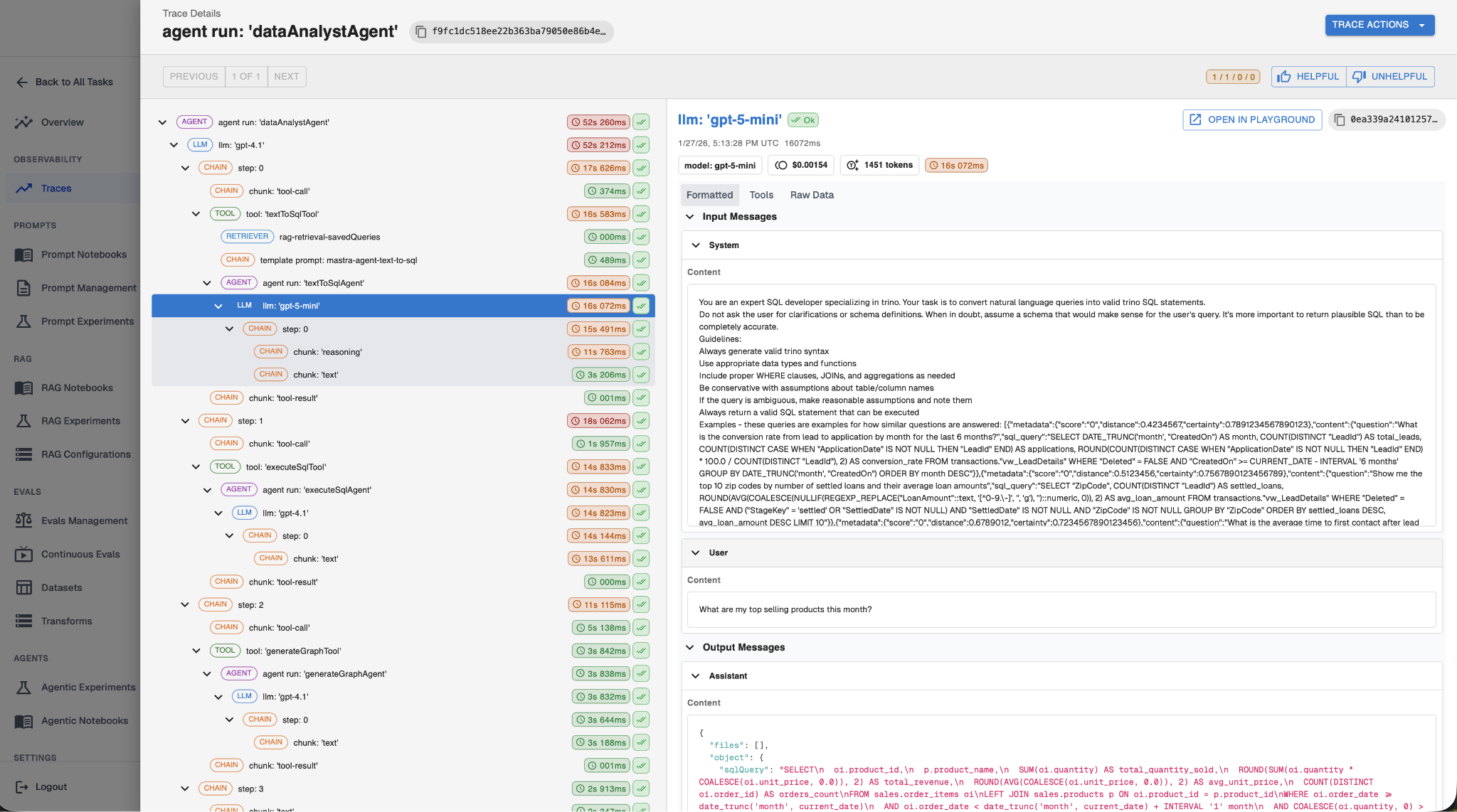
Both platforms are built on OpenTelemetry, which means you can instrument once and avoid vendor lock-in. The difference is in the semantic conventions and the depth of LLM-specific detail each captures.
Langfuse uses its own observation-centric data model with observation types like `generation`, `span`, `tool`, `retriever`, `agent`, `evaluator`, and `guardrail`. It supports OpenTelemetry ingestion and a range of auto-instrumentation packages. Sessions, user tracking, environments, tags, and token/cost tracking are all first-class.
Arthur is built around the OpenInference semantic conventions, which were designed specifically for LLM workloads. In practice that means:
- Richer LLM call detail (prompts, completions, tokens, cost, model parameters) captured by default
- First-class retrieval and re-ranking spans, important for RAG-heavy agents
- Explicit span types for LLM, TOOL, AGENT, CHAIN, RETRIEVER, and message/document/tool-call sub-types
- Out-of-the-box auto-instrumentation for LangChain, LlamaIndex, OpenAI, Google ADK, Mastra, AWS Strands, and CrewAI
The OpenTelemetry GenAI conventions are catching up, but if you compare traces from the same agent side by side, OpenInference still produces more expressive, debuggable traces today. Both platforms support sessions, user tracking, environment separation, and cost tracking. Where Arthur pulls ahead is in how those traces feed downstream into evals, experiments, and governance views without extra plumbing.
Prompt Management
Both platforms agree on the fundamentals: prompts belong outside your application code, every prompt needs versioning and rollback, and non-engineering teammates should be able to iterate without a redeploy.
Langfuse offers a clean labels-based deployment model (production, latest, custom labels), prompt composability so you can reference one prompt inside another, an interactive playground, and client-side caching so prompt fetches add no latency.
Arthur covers the same ground with versioning, environment tagging (dev, staging, prod), and a prompt library that lives outside the codebase. The differentiator is templating with conditional logic. Arthur prompts support Jinja2 syntax, so you can branch on request context instead of stuffing every possible instruction into one monolithic prompt:
{% if tier == 'enterprise' %} run enterprise prompt instruction {% else %} run the free tier instruction {% endif %}Without conditional templating, you either maintain a separate hardcoded prompt for every variant or pile every instruction into one massive prompt. The first explodes in maintenance cost. The second bloats context, increases latency and spend, and often degrades model accuracy as token counts grow.
A real Arthur customer building a SQL-generating agent uses this pattern to support dozens of database dialects, dynamically including only the dialect-specific instructions relevant to each request. The result is smaller prompts, more precise outputs, and lower per-request cost than a monolithic prompt would produce.
Arthur also ties prompt management directly to the experiments layer. When you change a prompt, you can replay real production traces against the new version and validate behavior before promoting it. Langfuse supports a similar workflow through datasets and experiments, but Arthur's templating-plus-experiments pairing is purpose-built for agents with many configurations.
Continuous Evaluations
This is where the two platforms diverge in philosophy.
Langfuse provides LLM-as-a-Judge evaluators that can run on production traces, user feedback collection, annotation queues for human review, and a custom scores API. Scores can be numeric, boolean, or categorical.
Arthur takes an opinionated stance: continuous evals should be unsupervised (no ground truth required), binary pass/fail (no ranges or scores), and specific (each eval targets one concrete failure mode). Common Arthur evals include answer groundedness, answer completeness, topic adherence, and goal accuracy. Every eval returns both a pass/fail decision and a natural-language explanation, which makes identifying a failure mode much faster.
Two patterns Arthur supports out of the box:
- Alerting on failure: When evals are high-confidence, failures fire alerts so the team can investigate before more users are affected.
- Human review filtering: For earlier-stage agents, failures queue interactions for human review so the team can analyze clusters and prioritize improvements.
Experiments and Supervised Evaluations
Langfuse supports datasets and prompt experiments through both the UI and SDK. You define a dataset, run a prompt or model variant against it, and score outputs against expected results.
Arthur takes the same idea further by separating experiments into three explicit levels, each chosen to match the change you are testing and give broader coverage:
- Prompt experiments run a prompt in isolation against a dataset of known inputs and outputs. Fastest iteration loop, ideal for prompt tuning.
- RAG experiments test whether your retrieval system returns the right context for known queries. Useful for catching the silent failures where bad context produces confidently wrong answers.
- Agent experiments run the full agent end-to-end with known inputs, evaluating both the final output and the intermediate traces. The most expensive level, but closest to production reality.
Supervised evals in Arthur follow the same best practices as unsupervised ones (binary, specific, examples in the prompt), with the added advantage of access to a ground truth. That enables checks like SQL semantic equivalence, tool-sequence matching, and factual correctness against an expected answer.
The general guidance: start narrow with prompt or RAG experiments to find the right change, then validate end-to-end with an agent experiment before promoting. Langfuse can be wired up to support similar workflows, but Arthur comes with a broad set of experimentation tools out-of-the-box.
Guardrails
This is one of the clearer architectural differences between the two platforms. Langfuse's approach is to bring your own guardrails library and use Langfuse to monitor it. Langfuse pairs with run-time security tools like LLM Guard, NeMo Guardrails, Lakera, Prompt Armor, or Microsoft Azure AI Content Safety. It is a strong observability story for guardrails, but the enforcement itself lives in whichever third-party library you choose to integrate.
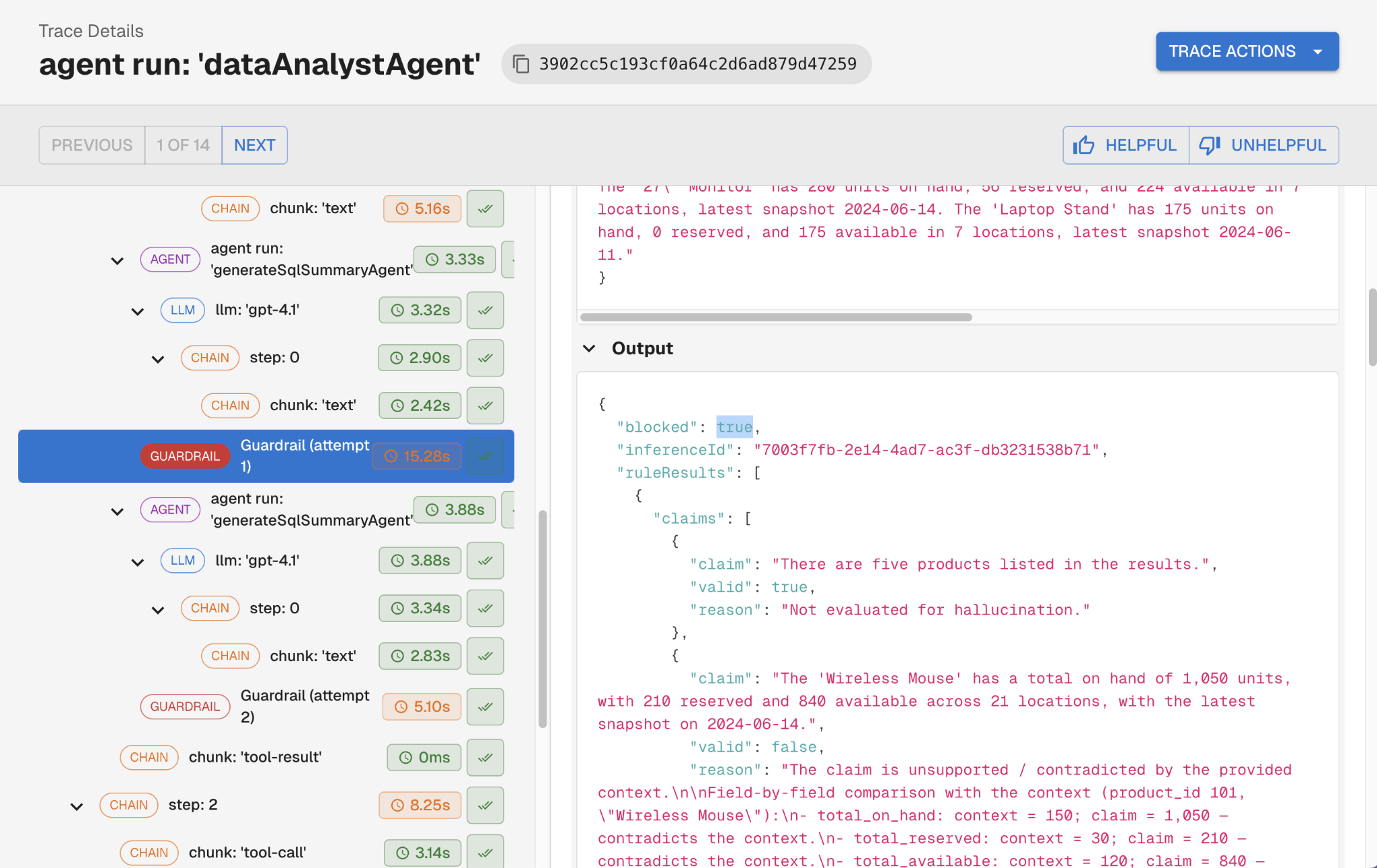
Arthur ships native, in-line guardrails as part of the platform, no third-party library required. Arthur supports 2 types of guardrails: Pre-LLM and Post-LLM
Pre-LLM guardrails run before the user's input and assembled context are sent to the model:
- PII detection and redaction
- Sensitive data blocking (credentials, credit card numbers, proprietary data)
- Prompt injection detection
Post-LLM guardrails run after the model returns, before the response reaches the user or downstream system:
- Hallucination detection
- Toxicity detection
- Tool and action validation
- Output format compliance
The more powerful pattern Arthur enables is using post-LLM guardrail failures as a self-correction loop. When a hallucination check finds an unsupported claim, instead of surfacing an error to the user, Arthur feeds the flagged content back to the LLM with a targeted correction prompt. The agent retries, the corrected output runs through the guardrail again, and the loop continues until the response passes. The user only sees responses where every factual claim is grounded.
If real-time interception is important to your use case (and for any agent handling regulated data, customer PII, or external-facing responses, it should be), Arthur provides this as a built-in capability. With Langfuse, you would integrate a separate guardrails library and use Langfuse to monitor it, which is a valid pattern but adds another vendor and integration surface to your stack.

Discovery and Governance
Langfuse provides project-level organization, role-based access control, environments, and protected labels that prevent unauthorized changes to production prompt versions.
Arthur is designed with enterprise governance review in mind. Governance views surface, for each agent:
- Tools the agent can call
- Models and LLM providers it uses
- Data sources and retrievers it touches
- Subagents it delegates to
- Named owner accountable for compliance
This matters because shipping an agent into an enterprise environment means passing compliance review. Builders who instrument thoroughly, send traces to a centralized location, run continuous evals and guardrails, and assign clear ownership have a much smoother path to production approval. Arthur's governance layer is built around making that evidence easy to produce and inspect; thus, making Arthur the perfect choice for enterprises with strict compliance requirements.
Deployment, Pricing, and Ecosystem
Both platforms are open source, self-hostable, and integrate broadly across the LLM ecosystem (LangChain, LlamaIndex, OpenAI, and most major SDKs). Where they differ meaningfully is in how the platform itself is deployed.
Langfuse runs as a single self-hosted application (or as Langfuse Cloud). Your traces, prompts, evaluation results, and dashboards all live inside the same deployment.
Arthur, on the other hand, is built natively as a federated, data-plane / control-plane architecture:
- The data plane - (Arthur engine) runs inside your VPC, right next to your AI workloads. Sensitive inference data, prompts, completions, retrieved documents, and PII stay local. Nothing crosses the boundary.
- The control plane handles dashboards, alerts, RBAC and SSO, prompt and dataset management, and the APIs your team interacts with. Only lightweight, anonymized metrics flow to it from the data plane.
The practical benefit: you get the operational simplicity of a managed control plane (no need to host dashboards, auth, or alerting infrastructure yourself) without the compliance tradeoff of shipping production inference data to a vendor. For regulated industries (financial services, healthcare, government) this is often the difference between an agent that clears compliance review and one that does not.
When to Choose Which
Choose Langfuse if you want a focused, open-source LLM observability and prompt management platform, you are comfortable assembling evaluation and guardrail logic from third-party libraries, and your primary needs are tracing, prompt versioning, and flexible scoring across datasets and production traces.
Choose Arthur if you are building agents headed for production and want an integrated toolkit that covers the full lifecycle in one place: OpenInference-native tracing, prompt templating with conditional logic, opinionated continuous evals, multi-level experiments (prompt, RAG, full agent), native pre- and post-LLM guardrails with self-correction, and built-in governance views. Arthur's federated data-plane / control-plane architecture also matters if your compliance posture requires that production inference data stay inside your VPC.
Interested in seeing Arthur in action? Book a demo with an AI expert or explore the Agent Development Toolkit.
SHARE


