Policy-Based Governance for Agentic AI Systems
Policy-based governance for agentic AI is the practice of defining explicit, machine-enforceable rules that control what autonomous AI agents are allowed to access, decide, and execute at runtime. Instead of relying on static documentation or after-the-fact audits, policy-based governance turns organizational policy into code that is evaluated and enforced on every agent action, allowing, blocking, modifying, or escalating behavior in real time.
This matters because the unit of governance has changed. Generative AI produces outputs: text, images, code. Agentic AI plans, decides, and acts. It calls tools, queries databases, hits external APIs, and chains multiple steps together with relative autonomy. Governing a system that takes actions in the world requires a fundamentally different control model than governing one that only produces text.
Why Agentic AI Needs a Different Kind of Governance
Traditional AI governance was built to review outputs before deployment. That model breaks down with agents for three reasons.
Autonomy. Agents make decisions without a human in the loop for every step. They select which tools to call and in what order, reason over retrieved context, and adapt their behavior to the situation. The exact path an agent takes is non-deterministic and emerges at runtime, so you cannot fully predict or pre-approve it during a design review.
Persistence and multi-step execution. A single agent request can fan out into dozens of LLM calls, tool invocations, and retrieval steps. Risk compounds across the chain. A small error early in execution, a bad retrieval or a misread instruction, can cascade into a wrong action several steps later.
Environment coupling. Agents are wired into real systems: internal APIs, customer data, payment flows, ticketing systems, and other agents. An agent operating with broad access to internal systems and sensitive data represents real organizational risk regardless of how well it was built.
The takeaway: risk emerges at runtime, in the actions an agent takes, not in a document written before deployment. Governance has to move into the execution loop.
What "Policy-Based" Actually Means
Policy-based governance rests on three ideas.
Policy-as-code. Rules are expressed in a machine-readable, versionable, auditable form rather than living in a PDF or a wiki. A policy might state that an agent can read from an inventory database but not write to it, that customer PII must be redacted before it reaches an external model, or that any refund over a threshold requires human approval. Because policies are code, they can be tested, version-controlled, promoted across environments, and rolled back, the same way mature teams treat prompts as first-class, versioned artifacts.
Runtime enforcement. Policies are evaluated at the moments that matter: before execution (is this input safe, does this agent have permission?), during execution (is this tool call allowed?), and after execution (is this output grounded, on-brand, and free of sensitive data?). Enforcement happens inline, before a bad input reaches the model or a bad output reaches the user.
The propose, evaluate, enforce loop. An agent proposes an action. A policy layer evaluates it against the relevant rules. The system then enforces an outcome: allow, block, modify, or escalate to a human. This loop is what separates governance from monitoring. Monitoring tells you what happened; policy enforcement decides what is allowed to happen.
Core Components of Policy-Based Governance
A complete policy-based governance system covers six areas.
Policy definition and boundaries. Define the agent's mission envelope: the scope of what it should do, the tools and APIs it is allowed to invoke (an allowlist), and the conditions under which it operates. Boundaries are most effective when they default to least privilege, granting only what the agent needs.
Access and data controls. Apply role-based or attribute-based access control (RBAC/ABAC) to what data and systems an agent can touch. Detect and redact PII and PHI before it leaves your environment. Block credentials, proprietary data, and other sensitive information from entering model context. For example, a major airline running a customer support agent puts every conversation through PII detection before anything reaches the model, ensuring sensitive customer data never leaves the corporate environment.
Action and tool boundaries. Control which tools an agent can call and validate that it selected the right tool for the request. Pre-LLM checks can catch prompt injection attempts designed to hijack the agent's behavior before they reach the model.
Human-in-the-loop triggers. High-risk actions, large transactions, irreversible operations, anything touching regulated data, should route to a human for approval rather than executing autonomously. Risk-based autonomy means low-risk actions run freely while high-risk ones require sign-off.
Continuous monitoring, observability, and audit trails. You cannot govern what you cannot see. Every tool call, retrieval, reasoning step, and policy intervention should emit telemetry. The teams that instrument early are the ones that ship with confidence, and those same traces become the audit trail compliance teams rely on.
Risk tiers. Not every agent needs the same controls. A customer-facing support agent that books and refunds tickets carries different risk than a back-office inventory agent. Governance policies should be customizable per use case, not one-size-fits-all.
How Organizations Implement Policy-Based Governance
In practice, mature implementations share a few architectural patterns.
Layered, progressive enforcement. Policies stack from broad to specific: organization-wide rules (no PII to external providers), use-case rules (this support agent stays on approved topics), and agent-specific rules (this agent can read but not write to the orders table). Each layer narrows the envelope.
Centralized governance with federated execution. A single control plane defines and reports on policy across the enterprise, while enforcement runs wherever the agents run, whether on Vertex AI, AWS Bedrock, or a custom stack. This is how organizations avoid the shadow agent problem, where agents proliferate across fragmented environments with no unified oversight. Discovery, automatically finding and cataloging agents across compute environments, is a prerequisite for governing them.
Guardrails and continuous evals as enforcement primitives. Guardrails intercept behavior in real time: PII redaction and injection detection before the model, hallucination and toxicity checks after it. The most powerful pattern uses a failed check to trigger a self-correction loop rather than returning an error to the user. Continuous evals run against production traffic to catch behavioral drift, like hallucination, topic adherence, or goal accuracy, before users report it.
Mapping to standards. Policy-based governance gives teams a concrete way to demonstrate compliance with frameworks like the NIST AI RMF, ISO/IEC 42001, and the EU AI Act, as well as regulations like GDPR and HIPAA. In practice, agents that emit thorough telemetry, run active guardrails and evals, and have a named owner clear enterprise compliance reviews faster.
Policy-Based Governance vs. Traditional AI Governance
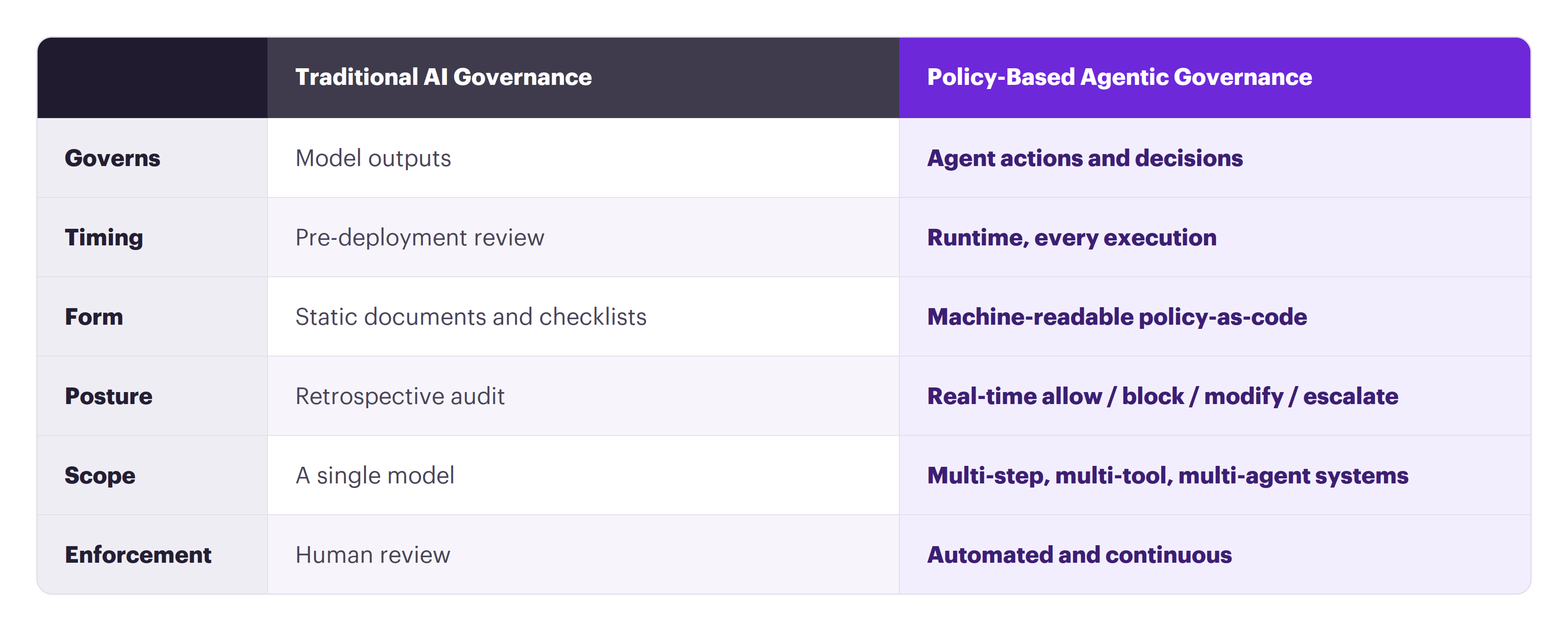
The shift in every row is the same: from reviewing outputs after the fact to enforcing rules on actions as they happen.
Where Governance Fits in the Agent Development Lifecycle
Policy-based governance is not a bolt-on at the end. It is the runtime layer that sits on top of everything else you build into an agent. Observability gives you the traces. Prompt management and experiments give you control over behavior. Continuous evals surface failures. Guardrails correct them inline. Governance ties it together with policy, accountability, and oversight.
This is the foundation of Arthur's Agent Development Lifecycle (ADLC), a rethinking of the traditional software development lifecycle for probabilistic, autonomous systems. In the ADLC, governance is treated as a first-class, automated discipline rather than a manual gate, because the emergent behavior and autonomy of agents make manual oversight impossible to scale. Teams that build observability, evals, and guardrails into their agents from day one are already most of the way to governable, enterprise-ready systems.
TLDR / Key Takeaways
- Policy-based governance for agentic AI defines explicit, machine-enforceable rules that control what an agent can access, decide, and execute at runtime.
- It governs actions, not just outputs, because agents plan, decide, and act autonomously across tools, data, and APIs.
- It relies on policy-as-code, runtime enforcement, and a propose-evaluate-enforce loop that can allow, block, modify, or escalate any agent action.
- Core components: policy boundaries, access and data controls (RBAC/ABAC, PII/PHI protection), tool boundaries, human-in-the-loop triggers, observability and audit trails, and risk tiers.
- Implementation favors layered enforcement and centralized governance with federated execution, mapped to standards like NIST AI RMF, ISO/IEC 42001, the EU AI Act, GDPR, and HIPAA.
- Governance is the runtime layer of the Agent Development Lifecycle, built on observability, evals, and guardrails.
Arthur helps enterprises discover, govern, and continuously evaluate agentic AI across any environment. See how Arthur's discovery and governance platform brings policy-based control to your agents, or book time with an AI expert to get started.
SHARE


