What Is a Non-Human Identity for AI Agents?
What is a non-human identity?
A non-human identity (NHI) is a digital identity assigned to something that is not a person: a service account, an application, an API key, an OAuth token, a workload credential, a bot, and increasingly an AI agent. It is how software authenticates, receives permissions, and acts inside your systems without a human logging in.
Think of it as a digital passport for the agent. A good NHI answers five questions:
- What is this agent?
- Who owns it and is accountable for it?
- What is it allowed to access?
- What has it actually done?
- How do you revoke it if something goes wrong?
NHIs are not new. Cloud environments have run on service accounts and machine credentials for years, and they already outnumber human identities by a wide margin. What is new is that AI agents are now a fast-growing class of non-human identity, and they behave nothing like the predictable service accounts that came before them.
Non-human identity vs. human identity
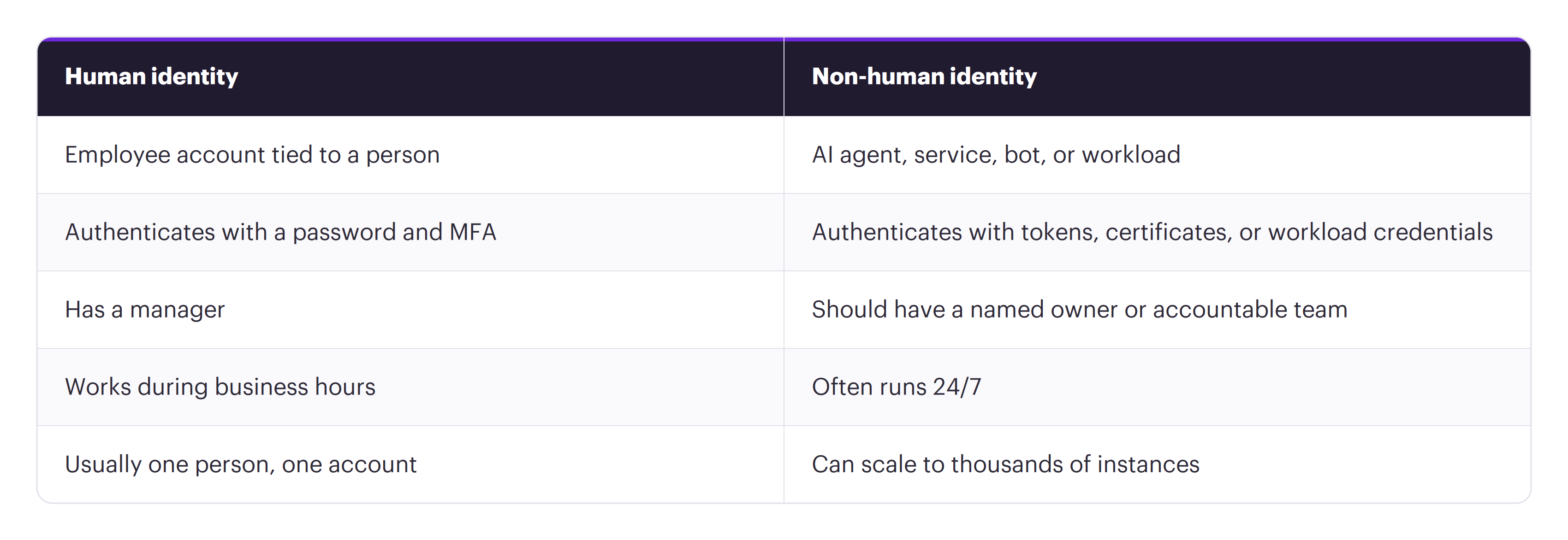
Why AI agents changed the non-human identity problem
Traditional software acts predictably. A backup job runs on a schedule. A web app calls a known API. A script executes fixed steps. You can reason about what a service account will do because it was written to do one thing.
AI agents are different. They reason, choose tools, call APIs, retrieve data, and delegate work to other agents, often with limited human supervision. The same agent can take a different path on two similar requests. That autonomy is exactly why identity, authorization, and accountability matter more here than they ever did for static workloads.
The most common failure is the shared-credential anti-pattern: many agents running behind a single API key or one broadly-scoped service account. It works in a demo and breaks in production for three reasons.
- You cannot tell which agent performed a given action.
- You cannot revoke one agent without disrupting the rest.
- A single compromised credential inherits access to everything it touches.
As agents enter the enterprise from every direction, through new applications, purchased solutions, and updates to software you have run for years, the number of these identities climbs from dozens to thousands. Without a unique identity per agent, that growth becomes agent sprawl that no one can see or control.
The four risks a proper identity solves
Accountability and audit trail. When an agent updates a record, sends an email, or approves a transaction, you need to trace it back to a specific agent, its owner, and the authority it acted under. A shared account makes every action anonymous. A dedicated identity produces an audit trail you can actually investigate.
Least-privilege access. An agent should get only the permissions it needs, not the same broad access as the human who operates it. A sales agent that reads assigned accounts and drafts proposals does not need admin rights to export the entire CRM.
Privilege creep and blast radius. Agents accumulate permissions over time as they take on new tasks, and unlike employees they have no standard offboarding when a project ends. Scoped, short-lived credentials keep the blast radius small if an agent is compromised through prompt injection, a poisoned tool, or a stolen token.
Lifecycle management. Every identity needs a full lifecycle: issuance, short-lived credentials, rotation, revocation, and retirement when the agent is decommissioned. Orphaned agent credentials are a standing risk.
Identity and access management for autonomous agents
Human-centric IAM assumes patterns that agents do not follow. Multi-factor authentication, interactive sessions, and periodic re-login were built for people at keyboards. Agents authenticate programmatically, run continuously, and act at machine speed, which forces teams into unsafe workarounds like hardcoded secrets and disabled MFA unless the identity model is built for machines from the start.
Applying least privilege to an agent means scoping permissions to its actual job and making them context-aware. A procurement agent might be allowed to approve purchases under a set threshold and require human sign-off above it. A customer support agent might read booking and account data but be blocked from touching payment systems directly. The point is to define narrow, explicit capabilities rather than handing the agent a role built for a human.
Agent-to-agent trust adds another layer. As agents call other agents, each one needs a way to verify who it is talking to, what organization that agent belongs to, and what authority it carries before exchanging data or triggering an action. Scoping what each agent can touch is the foundation for that trust.
Identity is necessary, but not sufficient
Most of the market treats non-human identity as a pure credentials problem: issue a token, scope it, rotate it, done. That is necessary, but it stops short. An identity you cannot discover, observe, or govern is just a credential. It tells you an agent is allowed to act. It does not tell you the agent exists, what it did, or whether its behavior is still acceptable.
Closing that gap takes three things working together, which is the basis of our Agent Security and Governance platform.
Discovery. You cannot assign an identity to a shadow agent you cannot see. Agents arrive through new projects, third-party tools, and vendor updates, and many never pass through a governance process. Automated discovery, using OTel telemetry, MCP monitoring, network-layer analysis, and cloud-provider APIs, finds unregistered agents so you can give them an owner and an identity in the first place.
Observability. An identity is only as useful as the record behind it. Tracing every tool call, retrieval, data source, and decision back to a specific agent turns identity from a static label into a live account of behavior. This is the same observability foundation that makes agents debuggable and auditable.
Governance. A complete identity carries policy with it: a named owner accountable for the agent, guardrails that intercept bad inputs and outputs in real time, continuous evaluations that catch misbehavior in production, and a revocation path to shut the agent down fast. Tying these controls to the identity is what makes an agent governable rather than merely credentialed, and it is the runtime half of the Agent Development Lifecycle.
Identity tells you who an agent is. Discovery, observability, and governance tell you whether you can trust it.
What enterprises should do now
- Give every production agent a unique identity and a named owner. No shared keys standing in for many agents.
- Apply least privilege with scoped, context-aware permissions, and require approval gates for high-risk actions.
- Use short-lived credentials instead of long-lived secrets, and rotate and revoke on a schedule.
- Log every action and tool call so each identity has a real audit trail.
- Discover unregistered agents continuously, because new ones appear every day.
- Attach guardrails and continuous evals to the identity, and keep a kill switch ready.
- Review agent access the way you review employee access.
Key takeaways
- A non-human identity gives an AI agent a traceable digital identity: what it is, who owns it, what it can access, what it did, and how to revoke it.
- Agents broke the old model because they act autonomously, and the shared-credential anti-pattern destroys attribution, least privilege, and containment.
- A proper identity solves four risks: accountability, least-privilege access, privilege creep and blast radius, and lifecycle management.
- Human-centric IAM does not fit agents. Permissions must be scoped, context-aware, and built for machine-to-machine trust.
- Identity alone is not enough. Discovery, observability, and governance turn a credential into an agent you can actually trust.
Give your agents an identity you can govern
An identity is the starting point. Discovery, observability, and governance are what make it mean something. Arthur brings all three together so every agent in your environment has an owner, an audit trail, and the runtime controls to keep it in line.
Book a demo with an AI expert to see agent discovery and governance in action, or explore the Agent Development Toolkit to start building agents you can trace, evaluate, and govern from day one.
SHARE


