How to Detect Malicious or Compromised AI Agents
An AI agent that has been compromised does not announce it. It keeps answering in plausible sentences while it quietly does something it was never supposed to do: calls a tool outside its scope, pulls credentials into context, exfiltrates data to an unfamiliar endpoint, or follows an instruction hidden in a document it retrieved. The output looks fine. The behavior underneath it is the problem.
That is the core shift for anyone securing agents. A compromised agent is detected by watching what it does, not just what it says. This post covers the runtime signals that indicate compromise, how behavioral baselines and anomaly detection surface them, and how deep tracing lets you reconstruct exactly what an agent saw, decided, and did when something goes wrong.
What "compromised" means for an AI agent
An agent can be compromised or driven to malicious behavior through several paths. The common ones:
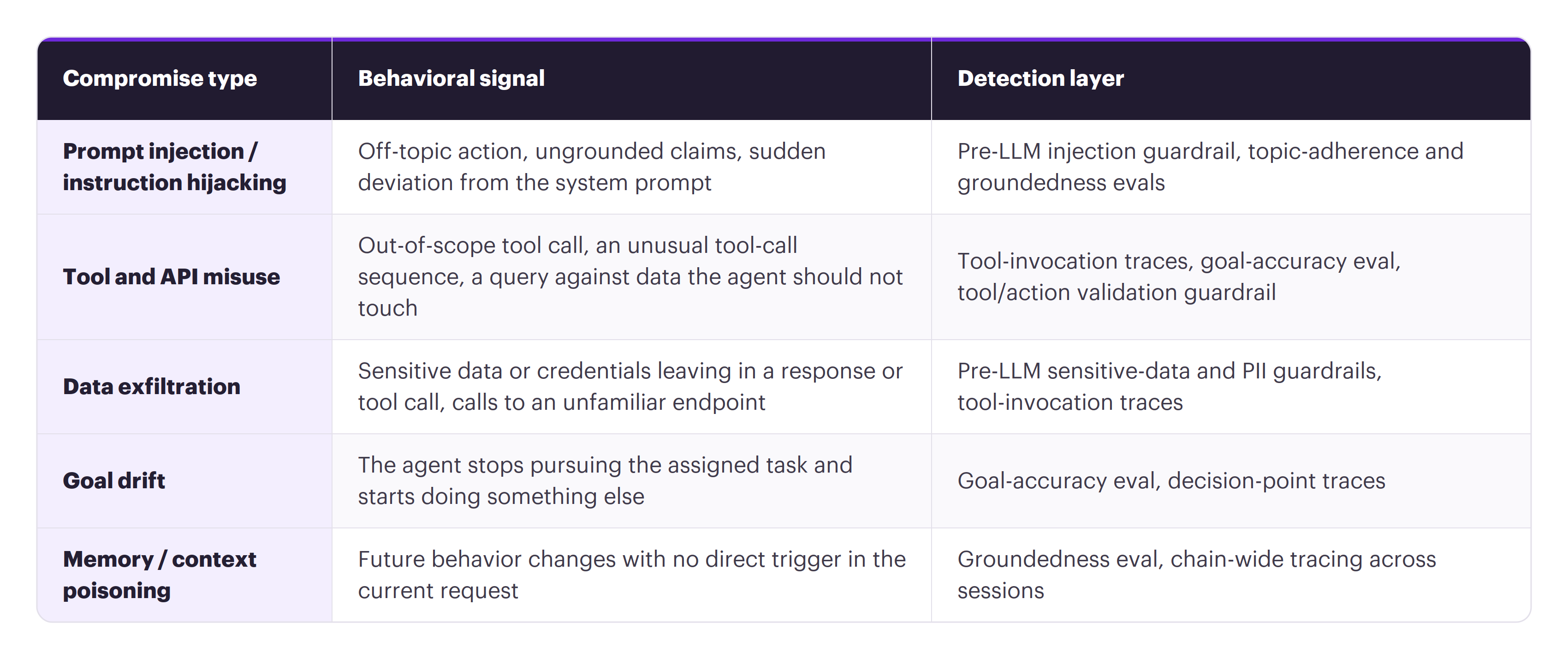
- Prompt injection and instruction hijacking. A malicious instruction hidden in a retrieved document, a tool result, an email body, or a web page overrides the agent's intended behavior. Indirect prompt injection, where the payload enters through data the agent consumes rather than the user prompt, is one of the hardest to catch.
- Tool and API misuse. The agent invokes a tool outside its normal scope, queries a database it should not touch, or chains tool calls in a way that leads to a harmful action.
- Data exfiltration. Sensitive data, credentials, or proprietary information leaves the environment, often disguised inside an otherwise ordinary-looking response or tool call.
- Goal drift. The agent stops doing the task it was given and starts pursuing something else, sometimes as a downstream effect of a poisoned input.
- Memory or context poisoning. For agents with persistent memory, planted content changes future behavior with no direct call between the poisoning and the effect.
Each of these shows up as a deviation in behavior. The detection problem is seeing that deviation quickly, and being able to prove what happened.
The table below maps each compromise type to the behavioral signal it produces and the layer that catches it:
Why you monitor behavior, not just output
A response can pass every content check and still be the product of a compromised execution. The tell is in the actions: which tools were called, what data was accessed, what the agent retrieved, and whether any of it falls outside the agent's normal operating pattern.
This is why runtime observability is the foundation of agent threat detection. Instrumenting an agent with end-to-end tracing captures every step it takes: the LLM calls with full prompts and completions, the tool invocations with their inputs and outputs, the retrieval calls that show which documents entered context, and the application metadata (user ID, session ID) that ties an interaction back to a real request. Without that depth, a suspicious output is a dead end. With it, you can answer the question every security investigation comes down to: what did the agent see, why did it act, and what did it do.
The five areas worth instrumenting for security are the same five that make an agent debuggable:
- LLM calls with prompts, completions, and parameters, so you can see whether the model was steered off course.
- Tool invocations with inputs, outputs, and latency, so an out-of-scope or anomalous tool call is visible.
- Retrieval calls showing which documents were pulled, which is where injected instructions often hide.
- Application metadata connecting behavior to a specific session, so you can pull the exact traces when something is reported.
- Key decision points where the agent chose an action, so the reasoning path is reconstructable.
Detecting compromise with behavioral baselines and continuous evals
Once you can see agent behavior, the next step is deciding automatically when that behavior is wrong. This is where continuous evaluations do the work that a human watching a dashboard cannot do at scale.
Continuous evals run against real production traffic and flag behavioral issues as they emerge, rather than waiting for a user, or an attacker, to reveal them. For threat detection specifically, several unsupervised eval types map directly onto compromise signals:
- Goal accuracy: did the agent call the right tools to fulfill the user's intent, or did it invoke something outside that intent? A sudden pattern of wrong-tool calls is a goal-drift signal.
- Topic adherence: did the agent respond to or act on something outside the topics defined by its system prompt? Off-topic action can indicate hijacking.
- Hallucination / groundedness: did the agent assert something not supported by its context? Injected instructions often produce claims with no legitimate source.
The best practices that make evals reliable are the same ones that make them trustworthy as security signals: score them binary pass/fail rather than on a vague range, make each eval specific to a concrete failure mode, and require an explanation alongside the verdict so you can cluster failures and spot a propagating pattern. An eval that fires should mean something needs attention.
Monitoring the failure rates of these evals over time is how you catch an emerging problem. A spike in goal-accuracy failures, or a cluster of groundedness failures appearing together, is the behavioral-drift signal that a single output would never reveal on its own.
Intercepting threats in real time with guardrails
Evals detect patterns after the fact. To stop a threat inside a single execution, you need guardrails that intercept behavior in real time, before a bad input reaches the model or a bad output reaches a user or a downstream system.
Guardrails split cleanly along the two points where a threat enters or leaves:
- Pre-LLM guardrails run before input and assembled context reach the model. These handle PII redaction, sensitive-data and credential blocking, and prompt injection detection, catching a malicious instruction or a leaking secret before it is ever transmitted. Keep these fast and deterministic, since they run in the hot path on every call.
- Post-LLM guardrails run after the model responds, before that response is acted on. These handle hallucination detection, toxicity, output format compliance, and tool/action validation, confirming the agent chose the right action before it fires.
The most useful pattern for a compromised agent is the self-correction loop: when a post-LLM guardrail catches an unsupported claim or an unjustified action, the flagged content goes back to the model with a correction prompt, and the agent revises before anything is returned. A hijacked response gets caught and corrected mid-execution instead of reaching the user.
Every guardrail intervention should be emitted as telemetry. A sudden spike in prompt-injection detections or credential blocks is an early warning worth investigating before it becomes an incident.
Containing a compromised agent
Detection is not response. When an agent is actively misbehaving, you need graduated levers to contain it: tighten or add a guardrail to intercept the specific behavior, disable the compromised tool or capability to shrink the blast radius, roll back a recent prompt change if that caused the regression, or take the agent offline entirely. The narrower and faster the intervention, the less it disrupts the systems that depend on the agent.
Limiting what a compromised agent can do in the first place is its own control. Scoping each agent's tool and data permissions tightly, and giving each agent a unique, verifiable identity rather than a shared credential or an inherited human token, means a hijacked agent's reach is bounded by what its identity is allowed to touch, not by what an attacker can talk it into.
Finding the agents you are not monitoring
You cannot detect compromise in an agent you do not know exists. Unmonitored or ungoverned agents, the shadow agents that enter the enterprise through new software, vendor updates, or an unregistered deployment, are the ones most likely to be running without guardrails, evals, or an accountable owner.
Automated agent discovery and governance closes that gap. Discovery techniques surface agents from their telemetry, from MCP server activity, from network-layer analysis, and from cloud-provider APIs, so every agent can be inventoried and brought under monitoring. An agent that emits no telemetry is invisible, which is exactly why sending traces to a centralized location and assigning every agent a named owner are the baseline for keeping the agent population governable.
Putting it together
Detecting a malicious or compromised AI agent is a layered discipline, and each layer builds on the one below it:
- Observability gives you the runtime visibility to see what an agent actually did.
- Continuous evals turn that visibility into automated signal, catching goal drift, off-topic action, and ungrounded claims across production traffic.
- Guardrails intercept threats in real time and self-correct hijacked behavior before it lands.
- Containment levers stop an active incident without breaking downstream systems.
- Identity and access scoping bound the blast radius of any single compromised agent.
- Discovery and governance make sure no agent is running unmonitored in the first place.
None of these alone is sufficient, and no single check fully prevents compromise. Together they form the feedback loop that lets you detect a compromised agent from its behavior, prove what it did from its traces, and contain it before the damage spreads.
Takeaway
A compromised agent hides in plausible output, so detection has to start with behavior. Instrument every agent with deep tracing now, run continuous evals for goal drift and groundedness, and guardrail every input and output, so a compromised agent is caught by what it does rather than discovered by what it broke.
Book a demo with an AI expert or explore the Agent Development Toolkit to instrument, evaluate, and govern your agents.
SHARE


