From Policy Chaos to Compliance Control

Your AI Agents are in production. Compliance requirements are mounting. Your team is manually checking policy adherence across dozens of models, scrambling to document attestations before audits, and hoping nothing slips through the cracks.
Sound familiar? You're not alone. As AI systems scale beyond prototype into mission-critical applications, the gap between "it works" and "it's governable" becomes a daily source of friction. Teams spend more time chasing compliance paperwork than building better models.
April’s platform release changes that equation entirely.
Policy Management That Actually Works
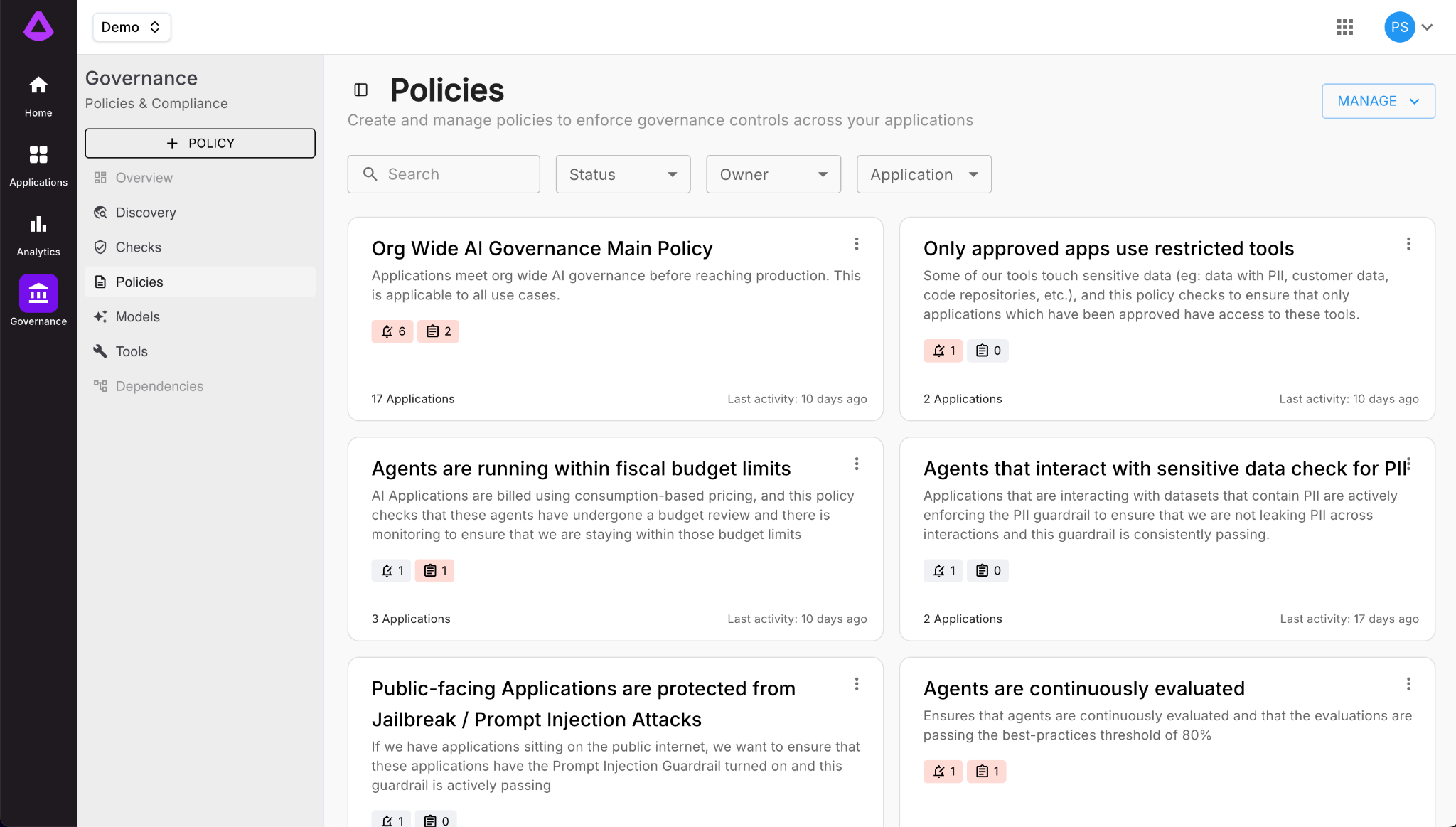
Your compliance team defines standards and engineers build models. But connecting those two worlds has been a manual nightmare of spreadsheets, Slack reminders, and last-minute scrambles.
Policy Management gives you a real system instead of ad-hoc processes. Create organizational policies with inline alert and attestation rules. Assign them to models with a single API call. Watch compliance status updates automatically as your models run.
- Atomic policy creation. Define alert rules and attestation requirements directly in policy definitions.
- Automatic rule materialization. When you assign a policy to a model, monitoring rules appear instantly without manual configuration.
- Workspace compliance overview. See compliance status across all policies, models, and rules in a single filterable table.
- Policy compliance history. Track how compliance status changes over time with full audit trails.
Compliance That Runs Itself
Manual compliance checks don't scale. By the time you realize a model violates policy, customers are already affected and your audit trail has gaps.
Automated Compliance Jobs run every 24 hours on every model with assigned policies. Policy violations trigger immediate webhook notifications to your incident response systems. Grace periods give teams time to remediate before formal non-compliance status kicks in.
- 24-hour compliance schedules. Every model with policies gets automatic daily compliance verification without manual intervention.
- Real-time webhook notifications. Your incident response systems get notified the moment policies are violated after enforcement delays expire.
- NEEDS_ATTENTION status. Teams get grace periods to fix violations before formal compliance failures are recorded.
- Rich compliance metrics. Track policy violations over time with detailed breakdowns by policy, rule, and model.

Your compliance posture stays current automatically. Issues surface before they become incidents. Your team focuses on building instead of checking boxes.
Agent Governance at Scale

Agents call tools, tools call APIs, and APIs cost money and touch sensitive data. But most teams have zero visibility into what their agents actually do in production.
Agent Discovery and Registration automatically finds agents in your workspaces. Track which tools they're using, how much they're costing, and whether they're following your governance standards.
- Automatic agent discovery. Agents get registered and tracked without requiring code changes or manual inventory management.
- Tool usage monitoring. See which tools your agents call most frequently and track latency patterns across tool types.
- Token consumption by LLM. Track prompt tokens, response tokens, and estimated costs broken down by model family.
- Agentic evaluation dashboards. Purpose-built dashboards for monitoring agent performance with date range and workspace filtering.
Expanded Data Connectivity
Databricks workflows. ODBC databases. CSV files in S3. Your data lives everywhere, but your ML monitoring has been stuck with whatever connectors happened to exist.
New Databricks and ODBC Connectors bring first-class support for enterprise data sources, plus enhanced Snowflake integration with proper schema management.
- Databricks connector. Connect Arthur directly to Databricks environments with enterprise-grade authentication.
- Universal ODBC connectivity. Monitor models fed by SQL Server, MySQL, PostgreSQL, Oracle, or any ODBC-compatible database.
- Enhanced Snowflake connector. Native schema, warehouse, and role management instead of generic database connectivity.
- CSV file format support. Load datasets directly from S3, GCS, or Azure Blob with configurable parsing parameters.
Your monitoring finally covers your real data pipeline. No more waiting for custom connectors or workarounds.
This platform release fundamentally changes how AI systems get governed at scale. Your team moves from firefighting compliance issues to preventing them and your auditors see systematic controls instead of ad-hoc processes.
PS — We've been working toward this comprehensive governance release for months, and honestly, we’re excited to see teams finally get the policy management system they deserve. The automated compliance jobs alone should save hours of manual checking every week. If you're curious about setting up policies for your models or want to chat about the agent governance features, hit us up directly at team@arthur.ai. See the full platform release notes for April 2026 here.
SHARE


