Beyond PII: Blocking Credentials and Proprietary Data Before It Reaches the Model
PII redaction gets most of the attention when teams talk about protecting data before it reaches an external model provider. It deserves the attention, but it is only half the problem. Credentials, API keys, secrets, and proprietary company data are just as dangerous when they leak into external LLM context, and they need their own pre-LLM guardrail.
An agent assembles context from many places: the user's message, retrieved documents, tool outputs, environment configuration. Any of those can carry a secret you never intended to send to a third-party model. This post explains what sensitive data blocking is, how it differs from PII redaction, and how to build it so organizational secrets stay inside your environment.
What is sensitive data blocking?
Sensitive data blocking is a pre-LLM guardrail that prevents credentials, API keys, secrets, and proprietary internal data from being included in the context sent to an external model provider.
It runs in the same place as PII redaction: before the user's input and assembled context are sent to the model. Pre-LLM guardrails intercept data on the way in, so a problem is caught before anything crosses the boundary to a third-party provider. Sensitive data blocking is one of these pre-LLM checks, alongside PII redaction and prompt injection detection.
The goal is simple: keep data you cannot afford to lose control of from ever leaving your environment.
PII vs. everything else
The two pre-LLM guardrails often get grouped together because they run at the same point in the execution loop, but they protect different things. The table below draws the distinction:
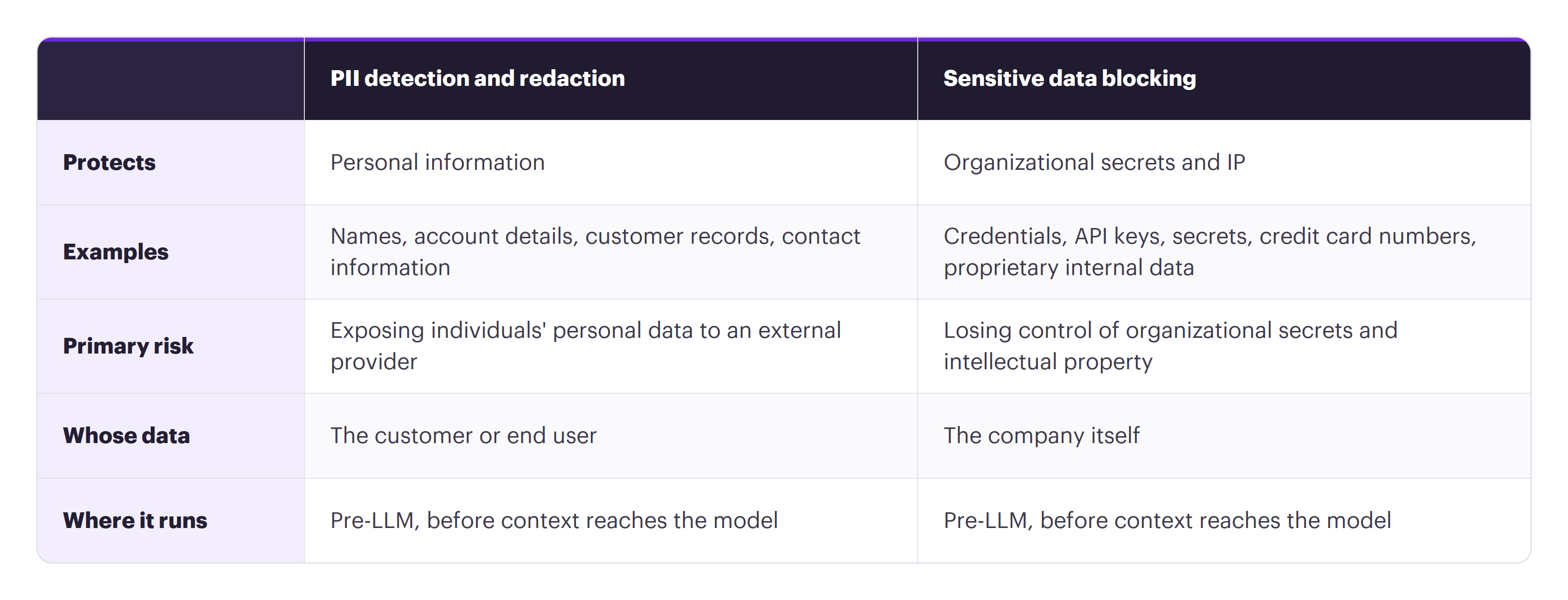
Both are pre-LLM guardrails, and both keep data from leaving your environment. The difference is the risk class they target. Redacting a customer's name does nothing to stop an API key from ending up in a prompt, and a secret-detection filter will not catch a phone number. A complete pre-LLM layer needs both.
What counts as sensitive beyond PII
Once you look past personal information, the list of things you do not want in external model context grows quickly:
- Credentials such as passwords, tokens, and authentication secrets.
- API keys for internal and third-party services.
- Credit card numbers and other payment data.
- Proprietary internal data, including source code, internal documents, and company IP.
The risk is the same across all of them: once this data is transmitted to an external model provider, you have lost control of it. You cannot un-send a prompt. Whatever policies the provider applies to logging, retention, or training are now the policies governing your secret. Blocking it before the call is the only reliable point of control.
Why it has to be customizable
There is no universal definition of sensitive data. What one agent must block, another can safely ignore, which is why blocking needs to be customizable rather than a fixed rule set. This is the one-size-doesn't-fit-all principle that governance has to account for: different agents and industries define sensitive data differently.
An inventory or e-commerce agent, for example, may need custom sensitive-data filters that go well beyond a standard PII check, catching internal SKUs, pricing logic, or supplier terms that a generic filter would never flag. A healthcare agent draws the line somewhere else again. The guardrail has to be configurable to each agent's context, so it blocks exactly what matters for that use case without over-blocking data the agent legitimately needs.
The practical implication: treat sensitive data definitions as a per-agent configuration, not a global constant.
Best practices
Keep pre-LLM guardrails fast and deterministic. They run in the hot path before every LLM call, so latency compounds across every request. Regex-based and rule-based checks catch credentials and secrets with minimal overhead. Avoid LLM-based checks at this layer unless absolutely necessary; a deterministic pattern match is faster, cheaper, and more predictable than asking a model to spot a secret.
Emit every intervention as telemetry. When the guardrail blocks something, produce a trace event, just like any other span in your agent. This lets you see how often sensitive data is being caught and what kind. Monitoring these events turns the guardrail from a silent filter into a visible signal.
Monitor pass/fail rates over time. A sudden spike in credential or secret detections is worth investigating before it becomes an incident. It might mean a new integration is leaking keys into context, or that an upstream change started pulling proprietary data into prompts. You want to catch that from a dashboard, not from a provider's logs.
Treat guardrails as first-class execution logic. They belong in the agent loop, not bolted on as an afterthought. A guardrail that only runs sometimes, or that can be bypassed, provides false confidence. If it is not always in the path, it is not a control.
Takeaway
PII redaction and sensitive data blocking solve two halves of the same problem: keeping data you cannot afford to lose control of from reaching an external model. PII protects the people your agent serves. Sensitive data blocking protects the organization itself, its credentials, its keys, and its IP.
Both belong at the same pre-LLM layer, both should be fast and deterministic, and both should emit telemetry you can monitor. Block organizational secrets at the same layer you redact PII, and you close a gap that a PII-only strategy leaves wide open.
Want to see customizable pre-LLM guardrails in action? Book a demo with an AI expert or explore the Agent Development Toolkit.
SHARE


