How Do You Give an AI Agent an Identity?
Every team deploying agents hits the same wall: the agent needs to act on systems, those systems expect an identity, and the identity models they have were built for humans and services, not for software that reasons and acts on a user's behalf at runtime. Give the agent a human's credential and you lose the ability to tell them apart. Give it a static service account and you hand it standing privileges it rarely needs. Neither fits.
There is no single accepted answer yet. Three approaches have emerged, and they solve the problem at different layers: a gateway that differentiates callers in front of your assets, scoped tokens issued just in time per action, and identity modeled as a subset of permissions assembled from context. Each works, each has tradeoffs, and the right choice depends on what you already run.
Why agent identity is hard
A human identity maps to one person who logs in, does a few things, and logs out. A service identity maps to a known process doing a predictable job. An agent fits neither. It acts on behalf of a user but is not that user. It decides what to do at runtime, so you cannot enumerate its actions in advance. And it often calls other agents and tools, so its activity spans systems that each want to know who is asking.
The core failure to avoid: an agent should never inherit the full identity or privileges of the calling user. If a user can reach twelve systems and the agent runs with the user's full identity, a single loose instruction or a poisoned document can turn all twelve into an attack surface. The agent needs an identity of its own, scoped to the task in front of it.
The three approaches below each enforce that principle differently.
Approach 1: Differentiate at the gateway
Instead of minting a unique identity for every agent, put a control point in front of the systems that matter and let it distinguish a human caller from a synthetic one, even when both use the same credential.
The argument for this approach is operational. Inventorying every agent and issuing each a unique identity does not scale when agents appear and disappear by the thousands. Sitting in front of critical assets does. The gateway asks a question most permission systems cannot answer: is the actor using this credential a person or an AI agent? If it is an agent, the gateway applies agent-specific policy regardless of whose credential it borrowed.
This also changes how inventory gets built. Rather than registering agents up front, you learn what agents exist by what they try to touch. Unknown agents get blocked by default, and a separate policy gets negotiated only once an agent's behavior has been observed. Inventory is created backwards, from activity rather than registration.
When it fits:
- You cannot realistically instrument or register every agent, especially third-party and vendor-embedded ones.
- You have a defensible set of critical assets worth putting a control point in front of.
- You want a default-deny posture for anything you have not seen before.
The test this approach poses is worth asking of any architecture: can your systems differentiate between a human and an AI agent using the same credential? If not, agent activity is invisible inside your existing access logs.
Approach 2: Issue scoped, just-in-time tokens
Give the agent no standing identity at all. Instead, mint a scoped token per action, audit and store it, and expire it quickly.
This approach applies zero-trust principles directly to agents. The building blocks:
- Deny by default. The agent starts with nothing.
- Least-authority tools. Each tool the agent can call carries the minimum privilege to do its job.
- No standing privileges. The agent holds no durable credential that an attacker could steal and reuse.
- Just-in-time delegation. For each action, the system issues a narrowly scoped token, records it, and expires it fast.
The effect is that a compromised agent, or one redirected by a malicious instruction, can only do what its current token allows, for the short window it is valid. There is no broad credential to exfiltrate and no standing access to abuse. Access management scoped to what each agent can touch pairs naturally with this: the token defines what the agent may do, and guardrails verify it did only that.
When it fits:
- You control the agent's runtime and can integrate token issuance into its action loop.
- Your downstream systems can accept short-lived, scoped credentials.
- You want per-action auditability, where every privileged step has a token you can trace back.
The cost is engineering effort. Just-in-time delegation requires a token-issuing layer and systems willing to honor ephemeral credentials, which is more work than reusing an existing account.
Approach 3: Model identity as a subset of permissions
Treat agent identity not as a credential but as a computed set of permissions, assembled fresh from context each time the agent acts. One framing builds this from four inputs:
- Everything the user can reach. The outer bound. The agent can never exceed the calling user's own access.
- What the agent is for. The intent of the task narrows that bound to only what this job requires.
- Device and network context. Where the request comes from further constrains what is allowed.
- What is allowed right now. Time and current conditions close the window, so permission is not open-ended.
The agent's effective identity is the intersection of all four. A read-only knowledge agent, for example, should end up with a permission set that cannot write anywhere, even if the calling user can, because its purpose does not require it. This directly addresses a failure mode that static permissions miss: combining individually permitted actions can still cause harm. A read-only agent connected to a CRM can exfiltrate sensitive data through a search query if its identity is scoped only by what the user can reach and not by what the task actually needs.
When it fits:
- You have a permission model rich enough to express user access, task intent, device and network context, and time.
- Your agents serve varied tasks where one-size identity would be too broad.
- You want identity to reflect current conditions, not a credential issued once and left standing.
The cost is that this is the most demanding approach to build. It needs all four signals available at decision time and a system that can compute the intersection on every action.
How the three compare
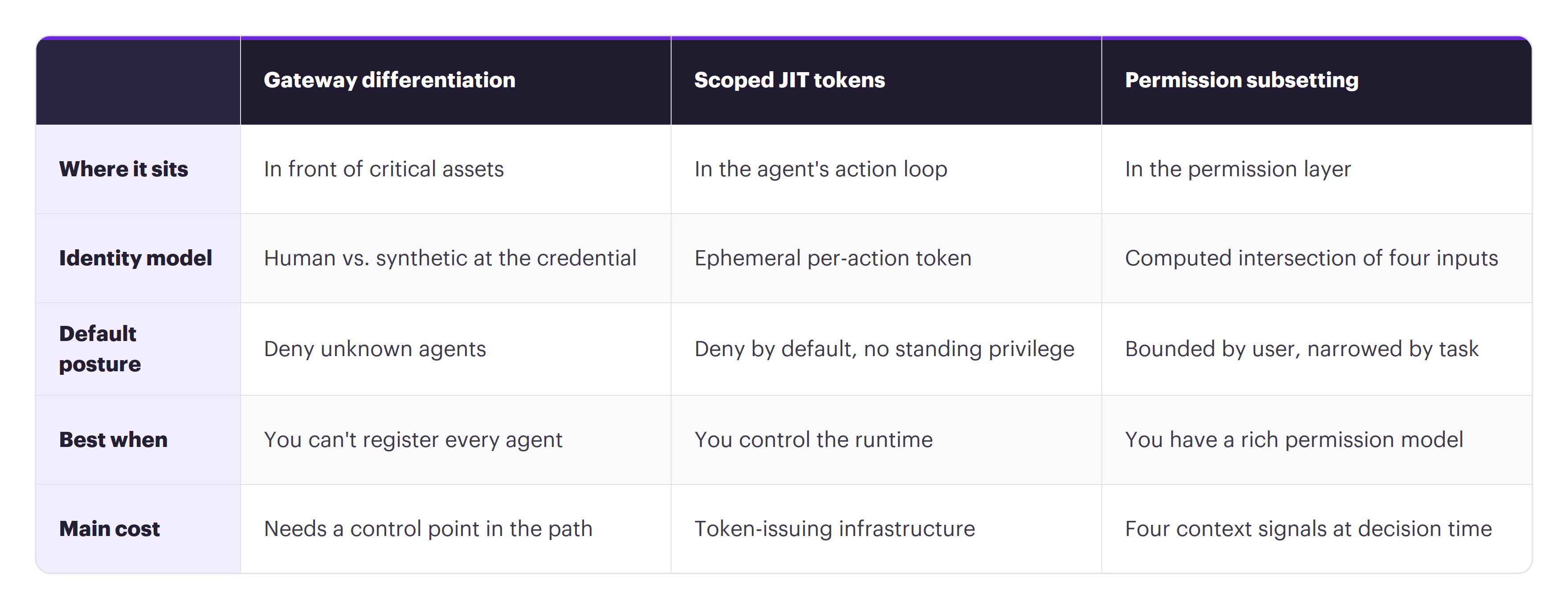
These are not mutually exclusive. A gateway can differentiate callers while the runtime behind it issues scoped tokens, and either can draw on context to subset permissions. The common thread is that none of them lets an agent run as the user. Each gives the agent a narrower identity than the person it acts for.
Identity is necessary but not sufficient
Scoping an agent's identity controls what it is allowed to reach. It does not confirm the agent used that access the way the task intended. An action can sit entirely within a correctly scoped identity and still work against the user's goal, which is why identity has to be paired with controls that watch behavior at runtime.
Two practices close that gap. Continuous evals assess whether the agent called the right tools for the user's intent, not just whether it was permitted to. And observability built on OpenTelemetry tracing captures the identity each action used alongside the decision behind it, so you can replay any privileged step and confirm it matched the task. Identity defines the boundary. These checks confirm the agent stayed inside it for the right reasons.
The short answer
You give an AI agent an identity by making sure it never runs as the user who invoked it. Three approaches do this at different layers: a gateway that tells humans and agents apart in front of your critical assets, scoped tokens issued just in time and expired fast, and identity computed as a subset of permissions from user access, task intent, device context, and current conditions. Pick the one that fits your runtime, and pair it with evals and observability so a correctly scoped identity is also a correctly used one.
Want to see agent identity, evals, and observability working together against real agent traffic? Book a demo with an AI expert.
SHARE


