What an Agent Acceptable Use Policy Must Include
Most AI acceptable use policies were written for the person at the keyboard. They tell employees not to paste customer data into a public chatbot and not to trust an answer without checking it. That governs what people type into AI. It says nothing about what an agent does once it is running with your credentials, calling tools, reading databases, and taking actions on your behalf.
An agent acceptable use policy has a different subject. The thing being governed is software, not a person. That one shift changes how every clause has to be written. A clause that says "use AI responsibly" means nothing to an agent. A clause that says "an agent may call only the tools listed in its registry entry" names something you can observe, check, and prove. Every clause in an agent AUP should name a tool, a data class, an autonomy level, or an owner. If discovery and monitoring cannot check it, it is a wish, not a policy.
This post gives you the template, clause by clause, with a column most policy templates leave out: how each clause gets verified. Treat it as a starting point to adapt with your own legal and compliance teams, not as legal advice.
Why an employee AI AUP does not cover agents
Most organizations are still early on AI policy at all. ISACA's 2026 AI Pulse Poll, which surveyed more than 3,400 respondents, found that only 38% of organizations have a formal, comprehensive AI policy, up from 28% in 2025. That figure covers AI policy in general, not agents specifically, and the agent-specific gap is wider still.
The public templates that do exist are built for employees. ISACA's acceptable use template and the others in circulation govern how staff may use AI tools. Swept.ai's template goes one step further than most, with a clause requiring written approval for an agent that takes actions, naming the agent, the systems it may access, and the actions it may take. That is the right instinct, but the agent is still treated as a tool an employee is approved to use, not as the entity the policy governs.
FINRA's 2026 Oversight Report points at what makes agents different: their autonomy and the scope of what they can reach. An agent decides which tool to call and acts without a human in the loop for each step. A policy written for a human reader cannot constrain that. The clauses below are written so that the agent's behavior, not an employee's intent, is what gets measured.
The agent AUP template
The following clauses are written to be adopted and adapted. Bracketed values are the ones you set for your own environment.
Clause 1, Scope. This policy applies to every AI agent that runs in [Company] environments or acts with [Company] credentials, whether built in-house, configured by business users, or embedded in purchased software, including agents found by discovery that are not yet registered.
Clause 2, Registration and owner. Every agent must have a registry entry and one named accountable owner before it runs in production. Agents found without an owner are treated as unapproved until an owner attests.
Clause 3, Permitted tools and MCP servers. An agent may call only the tools and MCP servers listed in its registry entry. Adding a tool or MCP server is a material change under the Agent Change Management Policy.
Clause 4, Permitted data classes. An agent may read or write only the data classes approved for its tier under the Data Classification Policy for Agents. Restricted data (for example PHI, PCI, MNPI, credentials) requires explicit approval and an active sensitive-data guardrail.
Clause 5, Autonomy ceiling. Each agent is assigned a maximum autonomy level: Observe (read-only), Advise (drafts only, humans execute), Act with Approval (human approves each action), or Act Autonomously (within guardrails, humans review exceptions). An agent may not operate above its ceiling.
Clause 6, Escalation triggers. The agent must route to a human before any irreversible action, any payment or transfer above [threshold], any external communication to [audience], any action on restricted data, and any action outside its listed tools.
Clause 7, Prohibited actions. No agent may create or modify identities or permissions, disable logging or guardrails, delete production data without approval, make final decisions in [regulated domains] without human review, call unapproved models or providers, or send restricted data to external model providers without redaction.
Clause 8, Telemetry. Every agent must emit traces to the enterprise telemetry pipeline using the Agent Metadata Standard.
Clause 9, Owner attestation. The owner attests at least every [90] days, and after any material change, that the registry entry is accurate and the agent operates within this policy.
Clause 10, Exceptions. Deviations require a time-boxed exception under the Agent Exception Policy.
Clause 11, Violations. Violations trigger review, autonomy demotion, or decommissioning, per the incident and kill-switch runbook.
How each clause gets verified
A policy is only as good as your ability to show it held. This is where an agent AUP can do something an employee policy cannot: because every clause names something observable, every clause maps to a source of evidence. The table below pairs each clause with where the evidence comes from, who checks it, and how often.
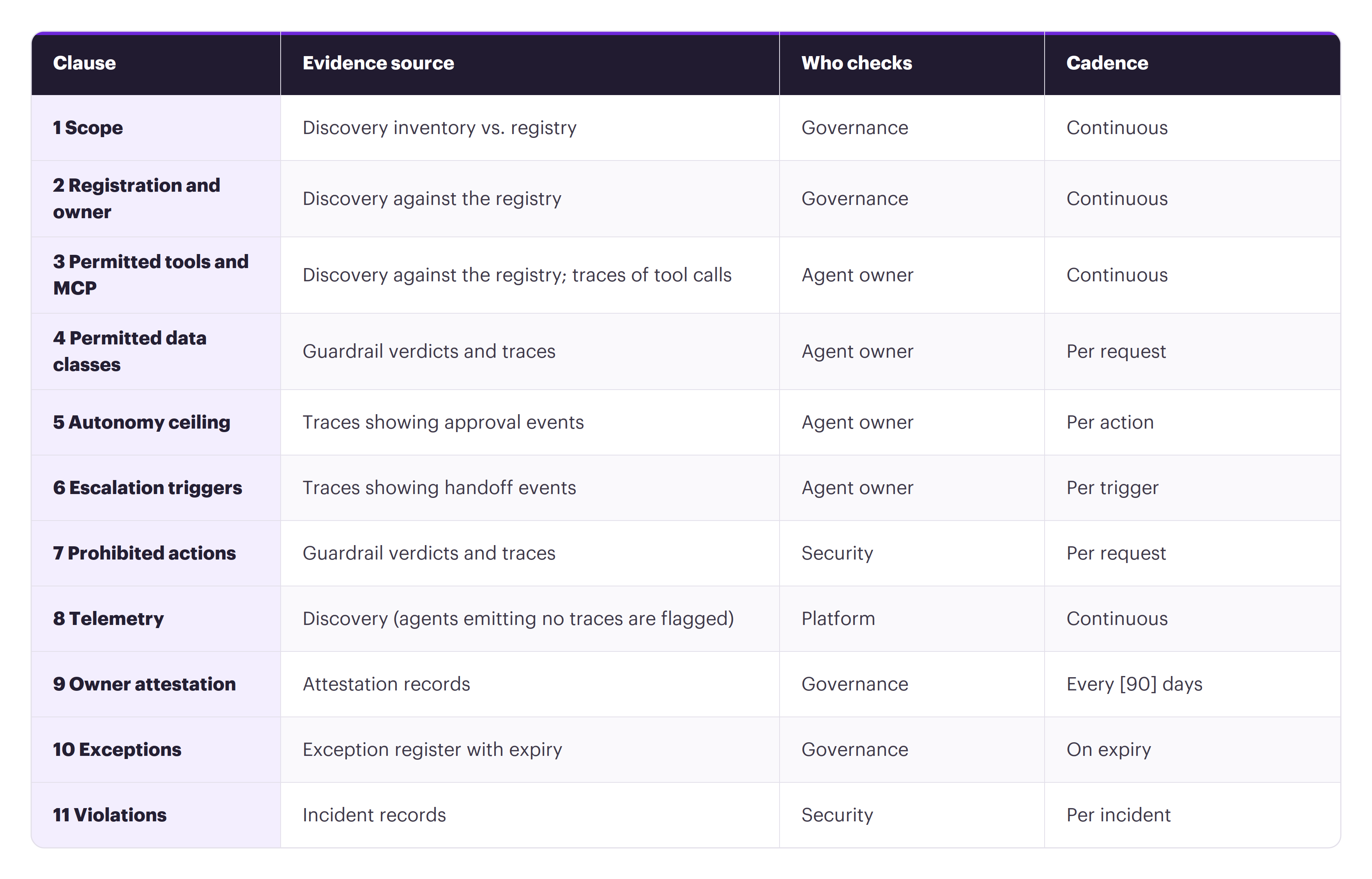
Three patterns hold this together. Clauses 2, 3, and 8 are verified by discovery comparing what is actually running against the registry, so an agent that was never registered, added a tool it was not approved for, or stopped emitting telemetry gets flagged. Clauses 4 and 7 are verified by guardrail verdicts and the traces around them, so a restricted-data read or a prohibited action leaves a record. Clause 5 is verified by traces showing that the required approval event happened before the agent acted. Clause 9 is verified by the attestation records themselves.
Autonomy ceiling mapped to Gartner's levels
Clause 5 borrows a model Gartner laid out in May 2026, which describes agent autonomy as a ladder rather than an on-off switch. An Observe agent has read-only access. An Advise agent drafts but a human executes. An Act with Approval agent needs a human to approve each action. An Act Autonomously agent operates within guardrails, with humans reviewing only exceptions. Assigning each agent a ceiling, and checking the traces to confirm it never acts above that ceiling, turns a vague "appropriate oversight" requirement into something measurable.
Escalation triggers
Clause 6 is where the human-in-the-loop requirement lives. The triggers listed (irreversible actions, payments over a threshold, external communications, restricted-data actions, out-of-scope tools) are the points where the cost of an autonomous mistake is highest. Design the agent so these route to a human by default, and instrument the handoff as an event in the trace so you can prove the escalation happened.
Rolling it out to agents that already exist
Writing the policy is the easy part. Applying it to an environment that already has agents running is where most programs stall, because you cannot govern an agent you cannot see. The order of operations matters.
Start with discovery. Before you can ask owners to attest, you need the inventory of what is actually running, including the agents nobody registered: the ones business users configured, the ones embedded in purchased software, the ones a developer spun up and forgot. Discovery across your cloud AI platforms, endpoints, SIEM, network signals, your telemetry sink, and MCP servers finds the agents the registry misses. Those get triaged, assigned an owner, and organized into a governed application.
Then run owner attestation. Once every discovered agent has a candidate owner, Clause 9's attestation becomes the gate: an owner confirms the registry entry is accurate and the agent operates within policy, or the agent stays flagged as unapproved. From that point the policy maintains itself through the verification sources in the table, and discovery keeps catching new agents as they appear.
How Arthur supports an agent AUP
Arthur is the layer that makes the verification column real. Read-only discovery across cloud AI platforms, endpoints via Jamf Pro, SIEM tools like Splunk and Elastic, network signals, the OpenTelemetry sink, and MCP servers finds agents the registry misses, which is what verifies Clauses 2, 3, and 8. Policies in Arthur carry alert and attestation rules, so Clause 9 becomes a recorded human sign-off rather than a reminder in someone's calendar. Guardrails return a verdict that your application enforces, and the verdicts plus the surrounding traces verify Clauses 4 and 7. Webhooks route violations to the incident tools you already use for Clause 11.
Arthur does not block an agent's tool calls on its own. It discovers, evaluates, records the verdict, and routes the signal, so your application and your owners act on evidence instead of assumption.
FAQ
What should an agent AUP include? Scope, registration and ownership, permitted tools and MCP servers, permitted data classes, an autonomy ceiling, escalation triggers, prohibited actions, telemetry requirements, owner attestation, an exception process, and a violations process. Each clause should name something observable so it can be verified.
How is an agent AUP different from an employee AI policy? An employee policy governs what people type into AI tools. An agent AUP governs what software does with your credentials, so its clauses constrain tools, data classes, autonomy levels, and actions rather than human behavior.
How do you enforce an agent AUP? Through verification, not just publication. Discovery checks the live inventory against the registry, guardrail verdicts and traces check data and action clauses, approval and handoff events in traces check autonomy and escalation, and attestation records check ownership.
To see how Arthur discovers unregistered agents and turns policy clauses into recorded evidence, book a demo.
This template is a starting point, not legal advice. Adapt it with your own legal and compliance teams.
SHARE


