Guardrails, Evals, and Policies: Three Tools, Three Jobs
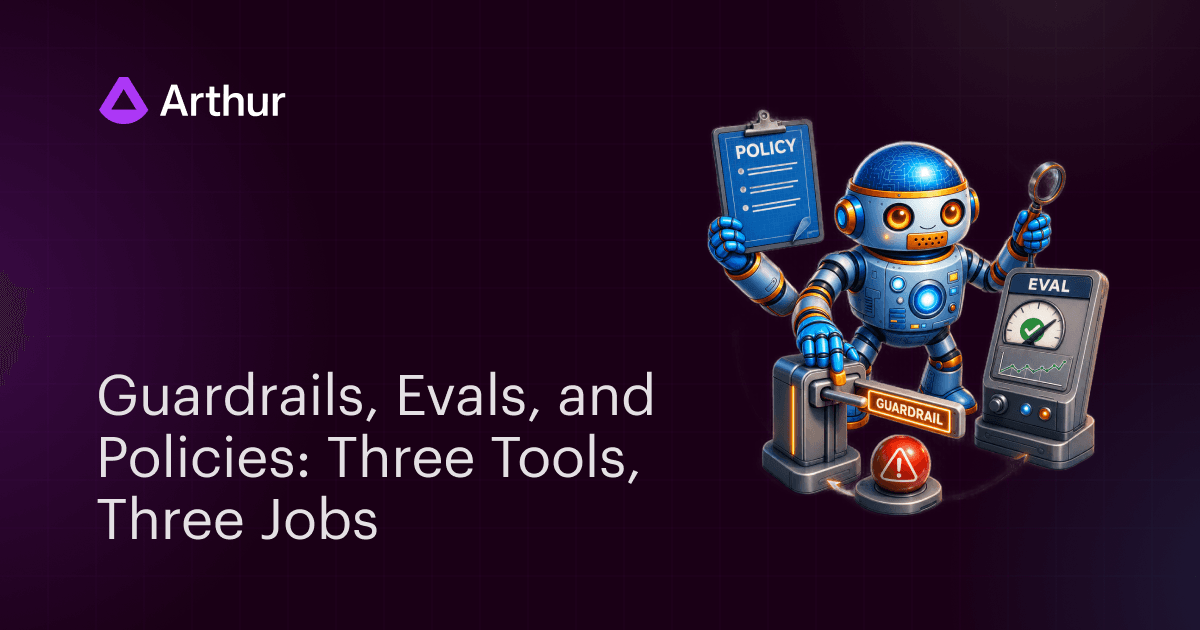
Guardrails, evals, and policies get talked about constantly, but ask a room of practitioners to draw clean lines between them and the answers start to blur. The confusion is understandable, because the same underlying check can wear all three hats depending on how you use it.
Take prompt injection detection. Run it in the request path and it works as a guardrail, blocking the attack in real time. Run it offline across yesterday's traffic and it becomes an eval, telling you how often you're being probed and where. Topic relevance behaves the same way: a metric you measure in testing, or a rule you enforce live on every response. What changes is the job you've assigned the check, not the check itself.
That reframes the question worth asking. Instead of "what's the difference between these tools?", ask "what job am I asking this check to do, and have I set it up to do that job?" Get that wrong and you end up measuring things you should be blocking, or blocking things you'd have been better off measuring. Knowing the three modes, and when to reach for each, is what separates a system you hope behaves from one you can actually stand behind.
Defining the three
Policies are the rules and intent. They describe what your system should and shouldn't do, in language a person can read and agree to. "We don't give medical advice." "We never expose customer PII." "We stay on topic." Policies are the shared definition of acceptable behavior that everyone, from legal to engineering to product, signs up to.
Guardrails are real-time enforcement. They sit in the request and response path and act in the moment, blocking a prompt injection attempt, redacting sensitive data, catching a hallucination before it reaches the user. A guardrail's job is to stop something from happening right now.
Evals are measurement and judgment. They tell you whether the system actually did what it was supposed to, how often, and why it failed when it did. Evals run against test sets before you ship and against live traffic after, turning vague confidence into evidence you can point to.
Where they overlap
It's easy to see why these get conflated. All three are answering versions of the same underlying question: what does "good" look like for this system?
Each one depends on a clear definition of acceptable versus unacceptable behavior. You can't enforce a guardrail or score an eval without first knowing what you're aiming for, and that target usually traces back to a policy. They share a vocabulary, and a change to one often implies a change to the others.
They also reinforce each other, and the reason traces back to the through-line for all of this: the goal is a robust, reliable system you can put in front of real users. A policy with no enforcement stays a wish. A guardrail with no measurement runs as a black box you can't tune. Evals with nothing to measure against produce numbers no one can act on. Each tool closes a gap the others leave open, and together they turn a promising agent into a dependable one.
Where they differ
The differences come down to three things: when they act, what they do, and what kind of failure they catch.
Timing. Policies are design-time. You write them before a line of code ships and revisit them as the product evolves. Guardrails are runtime. They act on every request and response as it happens. Evals span both, run before deployment to gate releases and continuously after to monitor live behavior.
Action. Policies describe. Guardrails block. Evals measure. A policy can tell you that exposing PII is unacceptable, but it can't stop it. A guardrail can stop it, but it can't tell you how often the attempt happens across thousands of conversations. An eval can surface that pattern, but it won't intercept the next one.
Failure mode. Each catches a different kind of problem. Policies catch misalignment between teams, the disagreement about what the system should even do. Guardrails catch the live incident, the bad output heading for a real user. Evals catch drift and regression, the slow degradation you'd otherwise miss until it became a trend.
When and why to use each
Reach for policies first. Before you build enforcement or measurement, you need agreement on intent. Policies align stakeholders and give the other two something concrete to point at. Skip this step and your guardrails and evals end up encoding assumptions no one actually validated.
Reach for guardrails when the cost of a single bad output is high and you need to act in real time. PII leakage, prompt injection, toxic content, hallucinated claims in a regulated domain. These are cases where catching the problem after the fact is too late, and you need something in the path that can intervene.
Reach for evals when you need to know whether the system works and why it fails. Use them to compare model versions, gate releases, track quality over time, and diagnose the root cause of incidents your guardrails flagged. Evals are how you turn one-off firefighting into durable improvement.
In practice they form a loop. Policies define intent. Guardrails enforce it live. Evals measure how well enforcement and behavior match intent, and what they reveal feeds back into sharper policies and better guardrails.
The takeaway
Guardrails, evals, and policies aren't competing options to pick between. You need all three, and the teams that ship AI with real confidence layer them deliberately. Policies set the standard. Guardrails hold the line. Evals keep you honest. Get clear on which job each one is doing, and the gaps that sink most production systems stop being invisible.
SHARE


