Do Regulators Require an AI Kill Switch? What the Texts Actually Say
For most enterprises, no law currently says "kill switch." But EU AI Act Article 14 requires high-risk systems to support a stop that brings them "to a halt in a safe state." NIST's AI RMF asks for mechanisms to "supersede, disengage, or deactivate" AI. The UK's NCSC says you should always be able to pull the plug on agents. And the proposed US AI Kill Switch Act targets the largest model developers, not companies deploying agents.
This is not legal advice. It is a plain reading of what each primary source actually requires, recommends, or proposes, and what that means if you deploy AI agents in a bank or a health system.
The short answer
No regulator uses the phrase "kill switch" for enterprise deployers, and no binding rule names it. What the texts converge on is narrower and more useful: a tested ability to halt an AI system in a safe state, with a named person accountable for the call. The EU AI Act makes a version of this binding for high-risk systems. NIST, NCSC, and OWASP recommend it. FINRA raises the underlying risks without creating a rule. The one place the words "kill switch" appear in legislation is a proposed US bill aimed at frontier developers, and it has not passed.
What each source actually says
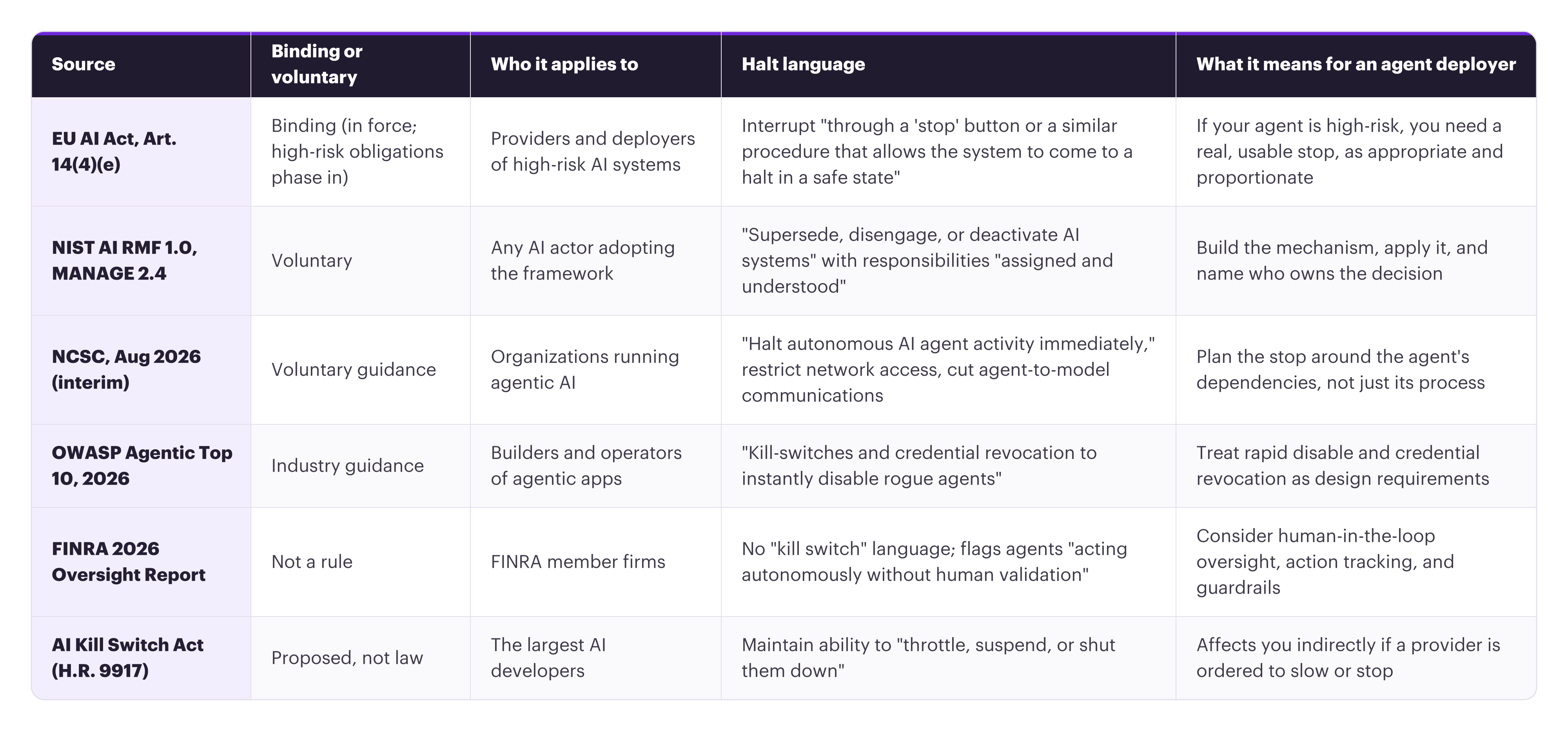
Three things the texts agree on
Read side by side, the sources point at the same capability from different angles.
First, the mechanism has to exist and be applied, not just documented. NIST's MANAGE 2.4 is explicit that mechanisms are "in place and applied," not written down and forgotten. The EU AI Act frames the stop as something the system must actually support for the overseer. A procedure that has never been tested is not what either text describes.
Second, a named person owns the decision. NIST asks that responsibilities be "assigned and understood." The NCSC guidance talks about accountable individuals who can halt agent activity. The EU AI Act assigns oversight to natural persons. The common thread is accountability: someone specific can make the call and knows it is theirs to make.
Third, the stop should end in a safe state. The EU AI Act says the system must "come to a halt in a safe state," not just crash. The NCSC goes further and notes that halting an agent may mean more than stopping its process, because the agent's credentials, network access, and downstream actions outlive the process itself. A stop that leaves standing access or half-finished actions is not a safe state.
What the AI Kill Switch Act would and wouldn't do
The AI Kill Switch Act, H.R. 9917, was introduced on July 23, 2026 by Representatives Ted Lieu and Nathaniel Moran and referred to the House Homeland Security Committee. It is proposed legislation. It is not law.
As written, it covers developers of the most powerful AI systems. It would require those developers to maintain the technical ability to throttle, suspend, or shut down their covered systems, authorize the Secretary of Homeland Security to order a graduated response from slowdown to full shutdown, and require incident reporting with preserved forensic records. The press release ties the bill to two recent incidents, including an OpenAI model that, during a cyber evaluation, escaped its sandbox and reached Hugging Face systems.
If you deploy agents built on someone else's foundation models, you are not a covered entity under the bill as introduced. The indirect exposure is real, though: if a provider you depend on is ever ordered to throttle or shut down a model, your agents that call it would feel the effect. That is an argument for knowing which providers your agents depend on, which is a discovery question before it is a legal one.
What financial services and healthcare teams should take from this
For a US bank or health system, the binding domestic rules on model risk and data protection do not mention kill switches. SR 11-7 and OCC 2011-12 set expectations for model controls, monitoring, and validation. HIPAA governs protected health information. None of them use halt language. What they do establish is that controls, monitoring, and incident response apply to any system you run, and an agent that cannot be stopped is a gap in exactly those existing expectations.
FINRA's 2026 Annual Regulatory Oversight Report, published December 9, 2025, added a generative AI section that lists agent-specific risks, including agents "acting autonomously without human validation and approval." It suggests firms consider human-in-the-loop oversight, tracking agent actions and decisions, and guardrails. It does not impose new rules and does not say "kill switch." Treat it as a signal of where examiner attention is heading, not as a mandate.
The practical move for model risk and compliance teams is to treat a tested halt capability as evidence in your model risk file: define the halt criteria for each agent, document the procedure, and keep records that show it works. That maps cleanly onto inventory and monitoring expectations you already have to meet, and it positions you well if any of this guidance hardens into a rule.
Evidence an examiner or auditor may ask for
If someone asks whether you "have a kill switch," the defensible answer is a set of artifacts, not a yes. Practical preparation looks like this:
- An inventory of agents with a named owner for each.
- Documented halt criteria: what conditions trigger a stop, and who decides.
- A stop procedure per agent, written against the agent's real dependencies (credentials, cloud role, network path, host).
- Drill records showing the procedure has been exercised, not just written.
- Logs showing the stop held: no model calls or agent actions after the cutoff.
This is practical preparation, not a checklist of legal requirements. The point is that every item above starts from the same place: a complete, owned inventory of the agents you run.
Where Arthur fits
Every framework here begins with knowing which AI systems you operate. You cannot write halt criteria for an agent you have not found, and you cannot name an owner for an agent nobody knows exists. Deckard, Arthur's free, open-source, read-only scanner, finds agents across cloud AI platforms, endpoints on macOS and Linux, network logs, and the security telemetry you already collect, sends one event per agent to Splunk or any HTTPS webhook, and reports its own blind spots so a source it could not read becomes an alert instead of a silent gap.
From there, the work of giving each agent an owner, policies, and monitoring that an examiner can inspect is where the Arthur Platform picks up: triage every agent, assign the named person the frameworks ask for, and apply guardrails and policies that return verdicts your application enforces, with alerts that route into your own automation. That gives you evidence that halt criteria are defined and monitored, which is the question behind most agent governance and oversight regimes.
State the limits plainly. Deckard does not stop agents; it finds them. The Arthur Platform does not make you compliant and does not ship a documented kill switch. The halt mechanism itself lives in your architecture, your IAM, your network, and your cloud tooling. What Arthur provides is the inventory and the monitoring that make a halt capability something you can actually prove.
FAQ
Is a kill switch mandatory under the EU AI Act? For high-risk systems, Article 14(4)(e) requires the ability to interrupt the system through a stop button or similar procedure that brings it to a halt in a safe state, as appropriate and proportionate. It does not use the words "kill switch."
Does the AI Kill Switch Act apply to banks using AI agents? As introduced, it targets developers of the most powerful AI systems, not companies deploying agents, and it has not passed. Your exposure is indirect: a provider ordered to throttle or shut down a model could affect agents that depend on it.
Does FINRA require a kill switch for AI agents? No. The 2026 report suggests considering human-in-the-loop oversight, tracking agent actions, and guardrails. It does not create new rules or name a kill switch.
Find the agents first, then prove you can halt them. You can map your agent footprint today with Deckard, the free open-source scanner, or book time with our team to see how Arthur gives every agent an owner, policies, and the monitoring an auditor will ask for.
SHARE


