What Counts as an AI Agent (and What Doesn't)
An AI agent is software that acts on a user's behalf. It takes actions, calls tools, edits files, runs commands, or makes requests, rather than just answering a question. Plenty of AI software never does this, and counting all of it as an agent inflates your inventory and makes it less useful.
If you are building an agent inventory for a security or governance program, the definition you use decides what lands in scope. Draw the line too wide and your dashboard fills with libraries and model runners nobody can govern. This post gives you a definition that holds up, the edge cases that make it real, and a few questions you can ask about any tool you find.
The only test that matters
An agent acts on the user's behalf. That is the only test.
Two easier questions are tempting, and both are wrong:
- "Is this AI software?" Lots of AI software answers questions and stops there. A model runner on a laptop is AI software. It is not an agent.
- "Can we detect it?" Detectability tells you what you can find, not what you are looking for. You can detect Docker on every host in your fleet. Docker is not an agent.
Software can be unmistakably AI and easy to detect and still fail the test. The question is never what it is made of or how visible it is. The question is whether it acts for someone.
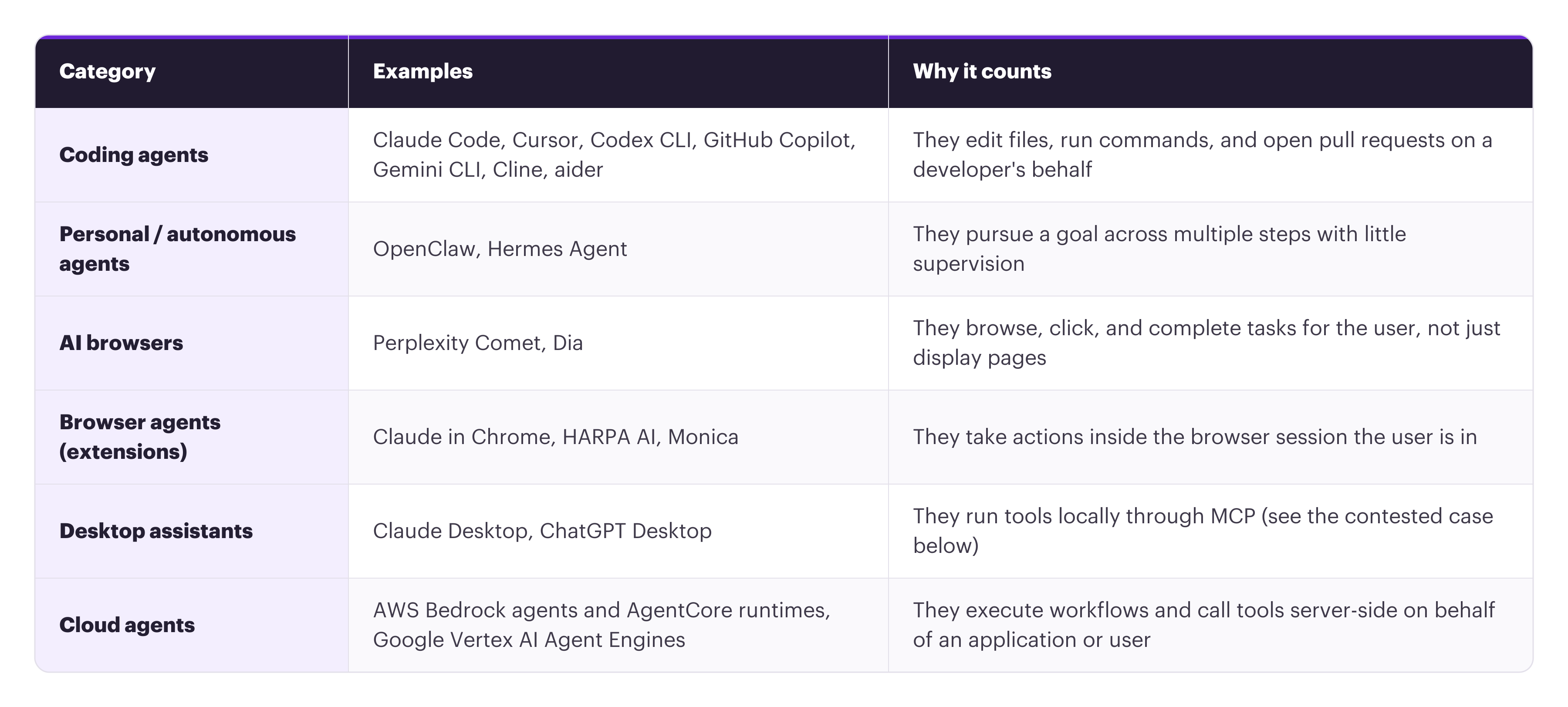
What counts
What doesn't
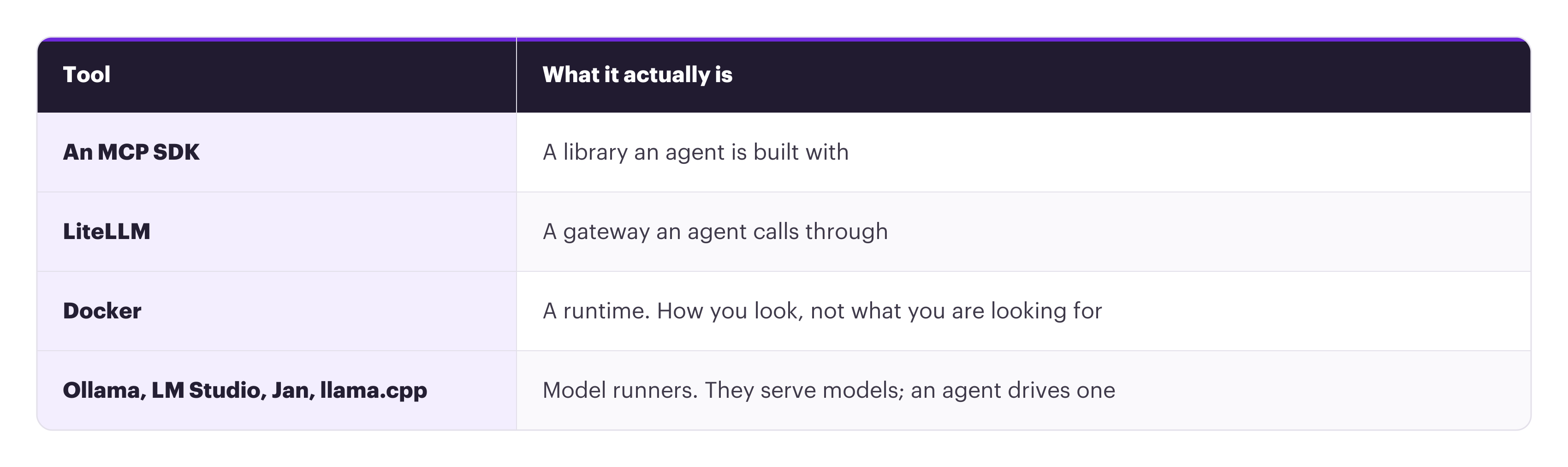
The line to hold onto: a model server or client library sitting on a laptop is not an agent running there. Reporting it as one overstates the finding. These tools matter, and you may well want to know where they are, but they belong in a different column than the agents that act.
The contested case: desktop assistants and MCP
Desktop assistants used to fail the test. A year ago, Claude Desktop and ChatGPT Desktop mostly answered questions. No autonomous execution, no tools, no actions. Under the definition above, they were not agents.
That stopped being true. Once these clients gained MCP support and began running tools locally, reading files, calling services, executing commands, they started acting on the user's behalf. So they now count.
Be honest that this is a judgment call, not a settled fact. The capability arrived through updates, not a version everyone agrees on, and reasonable people will draw the line on slightly different days. For an inventory, the safer error is to overstate an agent than to miss one. A desktop assistant you flagged and then cleared costs you a minute. One you never flagged, running tools against production, costs you more.
Why the line matters
Inflated counts erode trust. If your "agents found" number includes every Python library and model runner on every laptop, nobody believes the dashboard. The first time a reviewer sees llama.cpp listed as an agent, they stop trusting the rest of the list.
Wrong remediation. Agent policies (permissions, owners, guardrails) only apply to things that act. You cannot assign an owner and an escalation path to an SDK. If a model runner is sitting in your agent queue, someone wastes time trying to govern a thing that does not take actions.
Alert fatigue. A SOC that alerts on every AI-adjacent package will tune the alerts out within a week. Precision is what keeps an alert worth reading. Every false positive spends credibility you do not get back.
Honest negatives. Excluding something should be deliberate and documented, not an accident. This is where a disciplined scanner earns its keep: Deckard keeps the evidence for excluded tools and asserts they must not match, so "correctly not an agent" stays distinguishable from "detection quietly broken." A clean negative you can defend is worth as much as a true positive.
How to apply this to your own inventory
When you find a new tool and are not sure whether it belongs on the list, ask four questions in order:
- Does it take actions? Or does it only answer questions and serve output? If it only responds, it is probably not an agent.
- On whose behalf? An agent acts for a user or an application. If nothing is driving it toward a goal, it is infrastructure, not an agent.
- With what access? What can it reach: files, shells, APIs, databases, external services? This tells you the risk if the answer to the first two questions is yes.
- Who owns it? Every real agent needs a named owner. If you cannot name one, that is the gap to close first.
The first two questions decide whether it counts. The last two decide what to do about it.
Where this came from
Arthur built this definition into Deckard, our free, open-source agent scanner. It reports what it finds and documents what it deliberately does not. You can read the catalog, run it, and see the reasoning at arthur.ai/deckard.
FAQ
Is a chatbot an AI agent? Usually not. A chatbot that only answers questions does not act on the user's behalf. Once it can run tools, call APIs, or complete tasks, it crosses the line into agent territory.
Is an LLM an agent? No. An LLM is a model. An agent is the software that drives a model toward a goal and takes actions with the output. The model is the engine; the agent is the driver.
Are MCP servers agents? No. An MCP server exposes tools and data for an agent to use. It is part of how an agent acts, not the thing acting. It belongs in your inventory as an agent's capability, not as an agent itself.
SHARE


