How Insurers Govern AI Agents: Accountability, Authority Limits, and Exam-Ready Evidence
Insurers govern AI agents the way state regulators already expect them to govern AI: with a written program, accountable owners, controls scaled to consumer harm, and documentation an examiner can request. Agents add one hard requirement. You have to know every agent that can act on claims, policies, or customers, including agents embedded in vendor software, and limit what each one is authorized to do.
This is not legal advice. It's a practical read of what insurance regulators are already asking for and how that maps to agents that take actions rather than just score risk.
What "agentic AI" and Agent Discovery and Governance mean for an insurer
Most of the AI the NAIC has surveyed is predictive: models that score a risk, flag a claim for fraud, or rank a lead. Agentic AI is different because it acts. An agent can retrieve a policy, call a tool, change a record, move a payment, and send a customer a message, often chaining those steps together with little human involvement between them.
That shift is the governance problem. A predictive model produces an output a person then uses. An agent can be the person, executing the action itself. The controls that work for a scoring model (validation, drift testing, bias analysis) still matter, but they don't answer the new question: what is this agent allowed to do, and who said so?
Agent Discovery and Governance is the broader practice of finding every agent in the enterprise and bringing each one under an owner, a policy, and continuous monitoring. The AI agent inventory is where it starts, and for an insurer it's also the first thing an examiner can ask to see.
The accountability rule does not move to the vendor
When an insurer uses AI, it stays responsible for complying with insurance laws, consumer protection rules, and standards on fairness, accuracy, and unfair discrimination. State regulators oversee that use and can require a carrier to explain how AI is applied in underwriting, pricing, marketing, or claims. The NAIC's Model Bulletin on the Use of AI by Insurers, adopted in December 2023, makes the point directly: decisions made or supported by AI must comply with all applicable insurance laws, and regulators can request detailed information about that use during an exam.
Wisconsin's adoption of the model is explicit that this covers vendor-built systems. The state's AI bulletin expects every insurer to maintain a written AI Systems Program that addresses AI "whether developed by the Insurer or a third-party vendor," with controls commensurate with the potential harm to consumers, the degree of human involvement in the final decision, and the extent of reliance on third parties, across the full lifecycle through retirement.
So who is accountable when a third-party agent makes a claims decision? The carrier. A vendor can build the agent, host it, and operate it, but the insurer answers to the regulator for what it did to a policyholder. Contract terms help you hold up your end, and regulators expect to see them: audit rights, and a requirement that the vendor cooperate with regulatory inquiries. Those terms support your accountability. They do not transfer it.
Step 1: Build the AI agent inventory, including agents you didn't build
You can't govern, bound, or produce evidence for an agent you don't know exists, and an exam can request the inventory directly. An incomplete inventory is itself a finding.
Scope it to every agent that can touch a regulated workflow: claims intake and adjudication, underwriting and pricing, policy servicing, and customer communications. Then look everywhere those agents actually live:
- In-house agents built on cloud AI platforms.
- Vendor agents embedded in core policy, claims, and billing systems, and in the SaaS tools your teams already use.
- Agents employees installed themselves on their machines.
- Workloads that call a model provider's API directly, with no "agent" label on them at all.
The vendor-embedded category is the one carriers underestimate. Roughly half of the marketing models insurers reported to the NAIC came from third-party vendors, and agentic features are now arriving inside software that's been deployed for years. An agent you didn't procure can still act on your policyholders under your name.
Step 2: Tier agents by autonomy and customer impact
Not every agent needs the same scrutiny. Match the control to what the agent can do and how badly it can hurt a consumer, which is exactly the "commensurate with harm" principle the bulletins describe. A simple four-tier model works:
Four tiers cover most of what carriers run. A read-and-summarize agent retrieves and summarizes but takes no action, like one that condenses a claim file for an adjuster; it needs little more than logging and periodic review. A recommend agent proposes an action a human takes, such as suggesting a reserve amount, so it needs validation and a human decision on every output. A decide agent determines an outcome within set rules, like auto-approving a routine low-value claim, which calls for bounded authority, monitoring, and a clear override path. An execute agent moves money, changes coverage, or contacts a customer, such as issuing a payment or sending an adverse notice, and gets the strongest controls you have: hard authority limits, approval gates, and full logging.
The tier sets the baseline. An agent that only drafts internal summaries is low-stakes. An agent that can issue a payment or send a customer a letter with legal effect gets the strongest controls you have.
Step 3: Set authority limits and human approval gates
Technical capability is not organizational authority. An agent wired into your claims system can, at a technical level, change a claim's status. Whether it is permitted to do that, for this customer, in this workflow, at this moment, is a separate decision the insurer has to make and enforce.
The practical tool, described well in a recent argument for authority layers in insurance, is an authority envelope per agent: who it acts for, which systems and data it can reach, which actions it may take, any value limits, the conditions that require human sign-off, whether it can delegate to another agent, and when its authority expires. Pair that with a clean separation between recommendation, decision, and execution, so the strongest controls sit on the act of executing rather than on the model's complexity.
Which agents need human approval before acting? The ones whose actions carry legal or financial weight:
- Claim denials and payments above a set threshold.
- Coverage changes, beneficiary changes, and rescissions.
- Adverse underwriting decisions.
- Customer communications with legal or financial effect.
Routine, low-impact steps can run automatically once the conditions for automation are met. The goal is to put human authority exactly where the organization should not hand its judgment to software, not to bolt a reviewer onto every step.
Two more rules matter for agents that call other agents. Delegation should not pass permissions along: if one agent hands work to another, the second shouldn't inherit the first's full access. And revocation is part of authority design, not just incident response. You should be able to pull an agent's authority quickly, even when it's behaving correctly, because a data source changed or a vendor pushed an update. Give each agent its own scoped Non-Human Identity tied to its envelope, rather than letting it ride on an employee's broad access.
Step 4: Govern agents you can't modify
You will not have code access to a vendor's agent. Govern it at the boundary instead. Do the due diligence the bulletin expects before you rely on it, and put the right terms in the contract: audit rights and regulator cooperation. Then watch the perimeter you do control, the agent's identity, the data it can reach, and its network calls to model providers, and keep the ability to revoke its credentials and access without shutting down the whole business process behind it.
Step 5: Monitor continuously and keep exam-ready evidence
Governance has to run while the agent runs, and it has to leave a record. Wisconsin's exam section lists what a regulator may request: inventories of AI Systems that can produce adverse consumer outcomes, third-party due diligence, vendor contracts with audit and cooperation terms, and validation and drift testing. The NAIC's August 2026 working group materials go further for agents specifically, naming "unauthorized or poorly bounded agentic behavior affecting coverage, claims, or service" as a failure pattern, and citing defined action boundaries, override authority, tested kill switches, rollback, and full action logging as signs that controls work in practice.
Keep a per-agent record you could hand to an examiner:
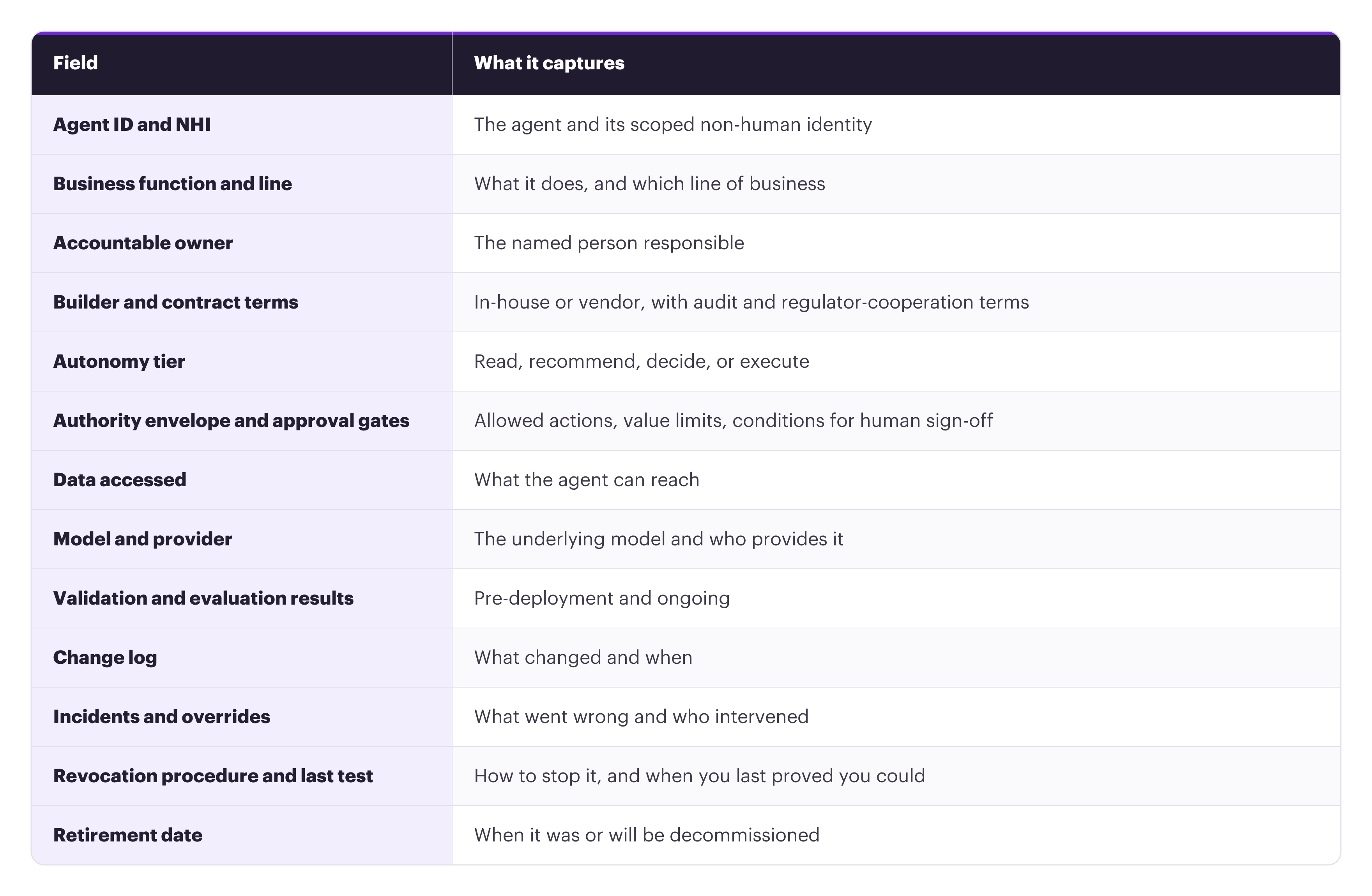
This record is what connects to the NAIC AI Systems Evaluation Tool, which 12 states were piloting as of March 2026 for market conduct and financial exams, with wider adoption anticipated. When an examiner asks how a specific agent reached a specific outcome, the per-agent record is your answer.
How this fits other regulated industries
The pattern repeats outside insurance. Banking, healthcare, and government all converge on the same sequence: inventory the agents, tier them by impact, bound what each is authorized to do, gate the high-consequence actions, and keep evidence. What insurance adds is market conduct exams and unfair claims settlement standards, which make the per-agent record less of a best practice and more of a thing you'll be asked to produce.
Where Arthur fits
Every step above depends on knowing which agents exist. Deckard is a free, open-source, read-only scanner that builds the starting inventory: agents on cloud AI platforms (Vertex AI Agent Engine, AWS Bedrock agents and AgentCore runtimes, plus the IAM roles calling Bedrock that CloudTrail reveals), agents on macOS and Linux endpoints through Jamf Pro, Compute Engine, EC2, or a local scan, workloads calling model providers in network logs, and agents visible in Splunk or Elastic data. It sends one event per agent to Splunk HEC or any webhook, and it reports the sources it couldn't read so a coverage gap raises a flag of its own.
Be clear about what it can't do. Deckard sees a vendor's SaaS platform only through network and identity signals, not from inside, it doesn't cover Windows endpoints, and it finds agents rather than blocking or approving anything. The stop, the approval gate, and the enforced policy are your architecture.
That's where the Arthur Platform carries the governance: triage, ownership, policies, guardrails, continuous monitoring, and alert rules that return verdicts your application enforces. It's where the authority envelopes and the per-agent evidence live, and it's how model risk management extends to agents that act. None of this makes an insurer compliant on its own. It gives the risk, compliance, and security teams the inventory, controls, and records a market conduct examiner can actually review.
FAQ
How do insurers govern AI agents? With the same program state regulators already expect for AI: a written governance program, accountable owners, controls scaled to consumer harm, and exam-ready documentation. For agents specifically, that means a complete inventory of every agent that can act on claims, policies, or customers, authority limits on what each one may do, human approval gates on high-impact actions, and continuous monitoring.
Who is accountable when a third-party AI agent makes a claims decision? The carrier. A vendor can build and operate the agent, but the insurer answers to the regulator for decisions that affect policyholders. Contract terms like audit rights and regulator cooperation support that accountability; they don't transfer it.
Which insurance AI agents need human approval before acting? The ones with legal or financial consequences: claim denials and payments above a threshold, coverage and beneficiary changes, rescissions, adverse underwriting decisions, and customer communications with legal effect. Routine, low-impact steps can run automatically once the conditions are set.
What evidence should an insurer keep for each AI agent? A per-agent record covering its identity and owner, business function, builder and contract terms, autonomy tier, authority envelope and approval gates, data and model used, validation and monitoring results, change log, incidents and overrides, revocation procedure and last test, and retirement date.
Does this replace a formal exam or a standards certification? No. This is how you prepare for market conduct and financial exams and align with the NAIC model and NIST AI RMF. It doesn't make you compliant by itself, and it isn't legal advice.
Governing agents starts with finding them. Map your agents with Deckard to build the inventory an exam can ask for, and book time with our team to connect ownership, authority limits, and evidence across every agent that can act on a policyholder.
SHARE


