AI Agent Vendor Questionnaire: 30 Questions for SaaS AI Features and Third-Party Agents
Most of the AI agents in your environment are ones you did not build. They arrive inside software you already bought, as new features switched on by a vendor, or as standalone AI products a team procured last quarter. Each one can read data, call tools, and take actions under credentials you issued. Your standard security questionnaire was not written to ask about any of that.
This is a buy-side instrument: a procurement policy and a vendor questionnaire for SaaS AI features and third-party agents. It is built around one question that changed in late 2026, and it asks for evidence rather than reassurance. It is not legal or audit advice. Use it with your own counsel, procurement, and compliance teams.
What TQA 9561 did and did not change
In September 2026, the AICPA published TQA Section 9561, addressing how a service organization's use of AI affects SOC 1 and SOC 2 examinations.
What it did not do matters most for buyers. As Schneider Downs summarizes, "AI does not create a separate SOC examination model, and the AICPA did not invent new criteria." Aprio puts it the same way: "There is no '2026 Trust Services Criteria.' No new control objectives, no separate AI module."
So there is no "AI SOC 2" to ask a vendor for. SOC 2 covers a vendor's AI through the existing Trust Services Criteria, but only when the AI agents are inside the system the report describes. That is the hinge. A SOC 2 report says nothing useful about an AI feature that sits outside the system description. And when a third-party AI provider performs functions that are part of the vendor's system, Schneider Downs notes the analysis "is the same as for any other subservice organization," handled by the inclusive or carve-out method.
The first question to ask a vendor, then, is not "do you have a SOC 2?" It is "is the AI feature we are buying inside the system your SOC 2 describes, and how is your model provider treated in that report?"
Procurement policy clauses
Put the rules in the policy before the questionnaire goes out, so enablement and contracts enforce them.
- Assess before enablement. AI features in purchased software are assessed under this policy before they are switched on, including features a vendor enables by default in an existing product.
- Material-change notification. The vendor notifies you within 30 days of a material AI change: a new model provider, a new agentic capability, or a new sub-processor handling your data.
- Responsibility allocation. Contracts allocate responsibilities between you and the vendor in line with ISO/IEC 42001 Annex A control A.10.2, which covers third-party and customer relationships.
The questionnaire by domain
Thirty questions, grouped so a reviewer can skip to what matters for a given purchase. Competitor questionnaires are thorough on data handling; the sections that separate this one are agent actions, oversight, and the commitment to stand behind the answers.
Scope (the TQA 9561 questions)
- Is the AI feature inside your SOC 2 system boundary and described in the system description?
- Which Trust Services Criteria categories cover it?
- How is your model provider treated in your SOC 2: inclusive method, carve-out, or outside the boundary entirely?
- Do you hold ISO/IEC 42001 certification, and does its scope cover this specific product?
Agent actions 5. Can the feature write, send, purchase, or change configuration, or does it only generate output for a human to act on? 6. List every action the agent can take on our behalf. 7. Can we disable individual actions, or require human approval per action? 8. Can the agent call other tools or external services? Which ones?
Identity and access 9. Under whose identity does the agent act when it touches our systems? 10. Are the credentials it uses scoped to least privilege and short-lived? 11. Can we restrict which of our systems and data the agent can reach?
Data 12. Which data classes does the feature process (including PII, PHI, PCI, credentials)? 13. Is our data used to train or fine-tune your models or any provider's models? 14. Which model providers and sub-processors are involved, and in which regions is our data processed? 15. How long is our prompt and output data retained, and can we set the period?
Change 16. How do you notify us of model, prompt, or tool changes that affect behavior? 17. Do you publish a public AI changelog? 18. Will a model or provider swap be treated as a material change under our contract?
Oversight 19. Can we stop a running agent, and how quickly? 20. Are per-action logs exportable to our SIEM in OpenTelemetry or another documented format? 21. Do you emit telemetry we can monitor, or is behavior opaque to us?
Security 22. Which OWASP Top 10 for Agentic Applications risks have you tested against (ASI01 prompt injection, ASI02 tool misuse, ASI03 privilege compromise, ASI06 supply chain)? 23. When was your last AI red team, and what was its scope? 24. How do you detect and prevent prompt injection in production?
Incidents 25. What is your AI incident notification SLA to us? 26. How would you detect that an agent took an unintended action on our data?
Regulatory 27. Does the feature make significant or automated decisions subject to CCPA ADMT rules? 28. Does it fall into any EU AI Act high-risk category? 29. Can you supply the documentation we would need for our own regulatory reviews?
Commitment 30. Will you contractually commit to these answers, or are they informational only? (Reco's guidance flags vendor answers marked "informational only" as a warning sign; a vendor that will not stand behind its answers in the contract has told you something.)
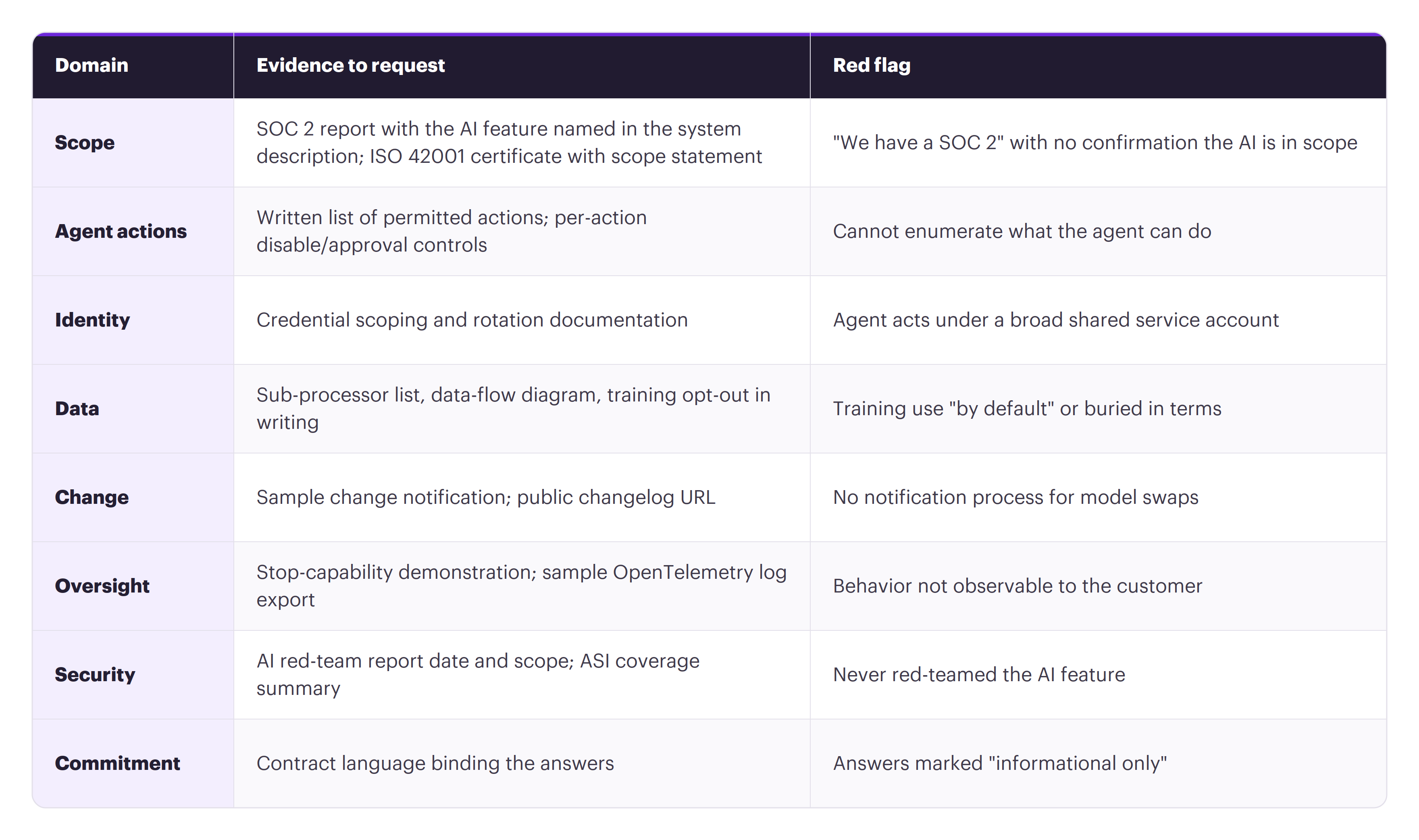
Evidence to request and red flags
Answers are claims. Ask for the artifact behind each one, and watch for the patterns that signal a vendor who has not thought this through.
Re-assessment triggers
A vendor that cleared review last year may not clear it today. Software you have run for years is quietly adding agentic features through ordinary updates, which is exactly how agents enter an environment without anyone deciding to adopt them. Re-run this questionnaire when:
- A vendor announces an AI or "copilot" feature in an existing product.
- A vendor changes model providers or adds a sub-processor.
- An agent's permitted actions expand from generating output to taking actions.
- A contract renewal or a new regulatory obligation lands.
Discovery is what makes these triggers real rather than aspirational. Arthur discovers agents and AI features running in your own environment, across cloud AI platforms and endpoints, so when a purchased tool switches on an agentic capability, it surfaces as a discovered agent you can route back through this questionnaire. That turns procurement from a one-time gate into a standing check against what is actually running. For the governance workflow once an agent is found, see Arthur's work on agent discovery and governance.
One more thing worth looking for in a vendor's own answers: where the data lives. A vendor whose architecture keeps your inference data inside your environment, with only anonymized metrics leaving it, is giving you a stronger answer than one that routes your data through its own systems by default. That is the kind of answer this questionnaire is built to surface.
FAQ
Is there an AI-specific SOC 2 we can ask vendors for? No. TQA 9561 confirmed there is no separate AI examination and no new criteria. SOC 2 covers a vendor's AI only when the agents are inside the system the report describes, which is why scope is the first thing to verify.
What is the single most important question? Whether the AI feature is inside the vendor's SOC 2 system description, and how its model provider is treated in that report. Everything else follows from scope.
How many questions should a vendor questionnaire have? Enough to cover scope, agent actions, identity, data, change, oversight, security, incidents, and regulatory exposure. The thirty here are organized so you can send only the domains relevant to a given purchase.
Does this replace our existing vendor security review? No. It extends it with the agent-specific questions a general security questionnaire does not ask.
Want to see which vendor agents and AI features are already running in your environment? Book a demo with an AI expert.
SHARE


