Agent Risk Acceptance Without Permanent Waivers
Every policy needs an exception path. Without one, teams route around the policy, and the governance program loses the visibility it was built to provide. Gartner's work on agent governance makes the point directly: applying uniform, over-restrictive controls across every agent pushes teams toward workaround and shadow development rather than compliance.
The problem is that most exceptions are granted informally and never close. A Slack approval, an email "fine for now," a ticket that nobody reopens. The deviation becomes permanent, and the risk the policy was meant to manage sits unmanaged and unrecorded.
An agent exception should be a record with three things a wish does not have: an expiry date, a compensating control, and a scope that discovery can check. When those exist, a lapsed waiver surfaces as a finding instead of quietly becoming the new normal.
This post is a workflow and template, not legal advice. Set the specific thresholds and approval authorities with your own risk, compliance, and security teams.
Why exceptions are a control, not a loophole
An exception process is what keeps a policy honest. If the only options are full compliance or silent violation, people choose silent violation when the policy blocks real work. A sanctioned deviation path gives them a third option that stays on the record.
The difference between a loophole and a control is structure. A loophole is open-ended and invisible. A control is time-boxed, owned, compensated, and observable. The rest of this post is about making every exception the second kind.
This is distinct from re-governing an agent whose risk surface has changed. Re-governance responds to a change in what the agent does. An exception sanctions a known deviation from policy for a defined period, with the risk accepted by a named person.
The exception request template
Every exception is a single record with these fields.
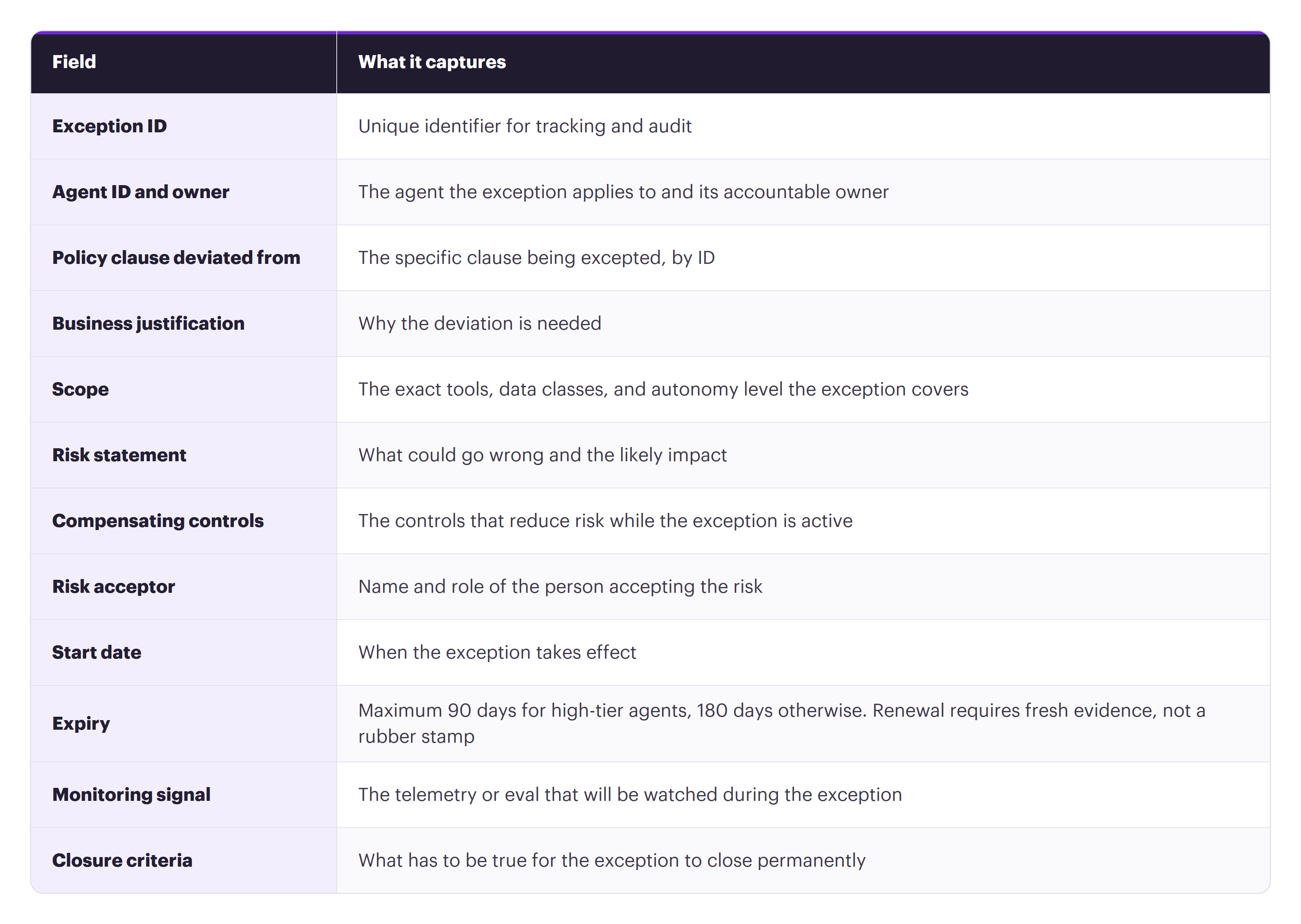
The expiry cap is the mechanism that prevents permanence. An exception does not renew automatically. At expiry it either closes because the underlying policy is now met, or it is re-requested with new evidence that the compensating controls are still working.
Who can accept which risk
Risk acceptance authority has to scale with risk. Two rules keep it clean.
The owner may not approve their own exception. The person who wants the deviation is not the person who accepts the risk of it. This separation is the whole point of an acceptor field.
High-tier agents and any exception touching restricted data (PHI, PCI, MNPI, credentials) require sign-off from the CISO or CRO. Lower-tier, lower-sensitivity exceptions can be accepted at the team or owner's-manager level.
This maps to established risk-management practice. NIST SP 800-37 frames risk acceptance as an explicit authorization decision made by an accountable official, and NIST SP 800-53 control CA-5, Plan of Action and Milestones, is the pattern of documenting a known weakness together with a planned, dated path to remediation. An agent exception is the same idea: a recorded, dated acceptance with a closure plan.
Compensating controls menu
An exception without a compensating control is just accepted risk with no mitigation. Pick at least one that fits the deviation.
- Lower the agent's autonomy ceiling for the duration
- Require human approval on the specific excepted action
- Add a guardrail targeting the risk the exception introduces
- Narrow the agent's tool list while the exception is active
- Increase eval sampling on the affected behavior
- Shorten the agent's credential lifetime
- Turn on enhanced logging for the excepted path
The compensating control is what lets a risk acceptor sign in good conscience. It is also what the monitoring signal watches, so that if the compensated risk starts to materialize, the exception can be pulled before expiry.
Expiry and re-review triggers
An exception should re-open for review on any of these, whichever comes first:
- Expiry date reached
- A material change to the agent (new tool, new data source, autonomy increase, model swap)
- Guardrail failure rate on the affected path rising above a set threshold
- An incident involving the agent
- Departure of the agent's owner or the risk acceptor
Periodic review of accepted risks is an explicit expectation in the NIST AI RMF, where GOVERN 1.5 calls for mechanisms to monitor and review AI risks over time rather than accepting them once and forgetting them. ISO/IEC 42001 reinforces the same discipline through its policy and internal-organization controls (A.2 and A.3), which require documented policies and clear accountability for the AI management system.
Tying expiry back to discovery
This is the step that separates a real exception process from a spreadsheet of good intentions.
At expiry, compare what the agent is actually doing against the scope the exception covered. Read-only discovery gives you the observed state: the tools the agent is calling, the data classes it touches, the model it runs on. The exception record gives you the sanctioned scope. Put them side by side.
If the deviation has ended, close the exception. If the deviation persists past expiry with no renewal, the agent is now out of policy with no cover. Flag it NEEDS_ATTENTION and route it to its owner.
Arthur supplies the mechanics that make this automatic. Grace periods and NEEDS_ATTENTION status track an agent's standing against policy, compliance jobs re-check that standing every 24 hours, and webhooks route a lapsed exception into the team's existing incident or ticketing tools. Attestation rules can require the risk acceptor to re-sign at each review, turning renewal into a recorded human decision rather than an inferred one. Because discovery reports what is actually running, it supplies the observed-versus-excepted comparison that tells you whether a waiver is still warranted or has quietly become permanent.
Treat the exception register itself as your GRC system's record. Arthur makes the expiry and the deviation visible; the register is where the risk acceptance lives.
FAQ
What is an AI agent policy exception? A recorded, time-boxed deviation from an agent governance policy, accepted by a named person, with a compensating control and a defined expiry. It lets teams keep working within a known, managed deviation instead of violating policy silently.
How long should an agent waiver last? Cap it. A common pattern is 90 days maximum for high-tier agents and 180 days otherwise, with renewal requiring fresh evidence that the compensating controls still hold. Set your own limits with risk and compliance.
Who signs off on agent risk acceptance? Not the agent's owner for their own exception. High-tier agents and exceptions touching restricted data should go to the CISO or CRO; lower-risk exceptions can be accepted at a lower level.
What happens when a waiver expires? Compare the agent's observed scope to the excepted scope. If the deviation has ended, close the exception. If it persists without renewal, the agent is out of policy and should be flagged and routed to its owner.
See how Arthur discovers agents, tracks them against policy, and surfaces lapsed exceptions before they become permanent. Book a demo.
SHARE


