Arthur Deckard vs Uber ADR: Endpoint Collector or Governance Platform for AI Agent Discovery?
Every security team that has tried to inventory AI agents runs into the same wall. Agents arrive through application teams, through purchased software that quietly adds agentic features, and through developers running coding assistants on their laptops. Nobody registers them in a central list. The question is not whether to discover them but how, and two distinct approaches have emerged.
One is the open-source endpoint collector, best represented by Uber's ADR (Agent Discovery and Response), released under Apache-2.0 in 2026. The other is the multi-source governance platform, which Arthur builds. They solve overlapping problems with different designs. This piece lays out what each does, where each fits, and how to think about combining them.
What an endpoint collector does
An endpoint collector runs on each machine and reports what it finds there. ADR is a clean example of the pattern. Its discovery and sensor components are one-shot command-line tools, run on a schedule on each endpoint, built on the Python standard library with a deliberately small footprint.
The design has real strengths. ADR reasons about evidence carefully: a name or path match alone never concludes that software is a given agent, and findings carry a confidence band based on how many independent signals agree. It reports coverage honestly, so a partial scan is marked partial rather than presented as complete. It treats MCP servers, skills, and plugins as first-class things an agent is wired to, and it ships a benchmark for evaluating detection of malicious agent behavior.
It is also scoped on purpose. ADR runs per host and reports per host. Its fleet-aggregation layer, its prevention hooks, and its red-team tooling are not part of the open-source release, and it ships no response or remediation code. It is a rigorous way to answer "what is on this machine," released as a collector and a benchmark rather than a managed service.
That makes the endpoint collector a strong fit when your agents live mostly on developer and employee machines, when you want to read and audit the detection logic yourself, and when you have the engineering capacity to run, aggregate, and act on the output with your own tooling.
What a governance platform does
A platform starts from a different question: not "what is on this host" but "what exists across the whole enterprise, who owns it, and is it governed." That changes the shape of the system.
Arthur discovers agents through four techniques that cover the ways agents actually enter an environment:
- Telemetry from OpenTelemetry streams, where listeners detect new agents, tools, and configuration changes.
- MCP server monitoring, flagging agents as they come online and detecting capability changes.
- Network-layer analysis, spotting LLM API call signatures that aren't instrumented through telemetry or MCP.
- Cloud platform APIs, reading running agents advertised by managed services like AWS Bedrock and Google Vertex AI.
Because the goal is fleet-wide governance, the platform adds the layers an endpoint-only collector leaves to you. Arthur spans cloud, endpoint, network, and SIEM sources rather than endpoints alone. It keeps a central run store with per-source health, so you can see which sources succeeded and which degraded. It tracks fleet-level first-seen and last-seen for each agent. And it carries a discovery UI and a triage workflow that takes an agent from detected to triaged, owned, and organized into a governed application.
The governance half is the point. Once an agent is discovered, Arthur lets you assign an accountable owner, classify risk, and apply policy: guardrails, continuous evaluations, and alert rules that return verdicts the application enforces. That is the step that turns an inventory into managed operations.
Where the two approaches meet: the open identifier catalog
The approaches are not mutually exclusive, and they share a design principle worth calling out. Detecting an agent reliably depends on knowing what to look for: the bundle IDs, package names, state directories, and other signatures each tool leaves behind. Those identifiers drift constantly, so the catalog matters as much as the scanning engine.
Arthur publishes its identifier catalog as an open spec, ai-detection-spec, where each identifier is read off a real install in continuous integration before it ships. Any scanner that implements the spec can produce the same findings. Deckard, Arthur's open-source discovery tool, runs that catalog against endpoint inventory from sources like Jamf Pro, Compute Engine, and EC2, and emits one normalized arthur.discovery.agent event per agent to Splunk, Elastic, or a webhook.
That open-catalog model means you can start with lightweight, auditable discovery and grow into full governance without re-instrumenting. The findings use the same vocabulary whether they come from a local scan or the platform.
Choosing between them
The decision usually comes down to scope and what happens after discovery.
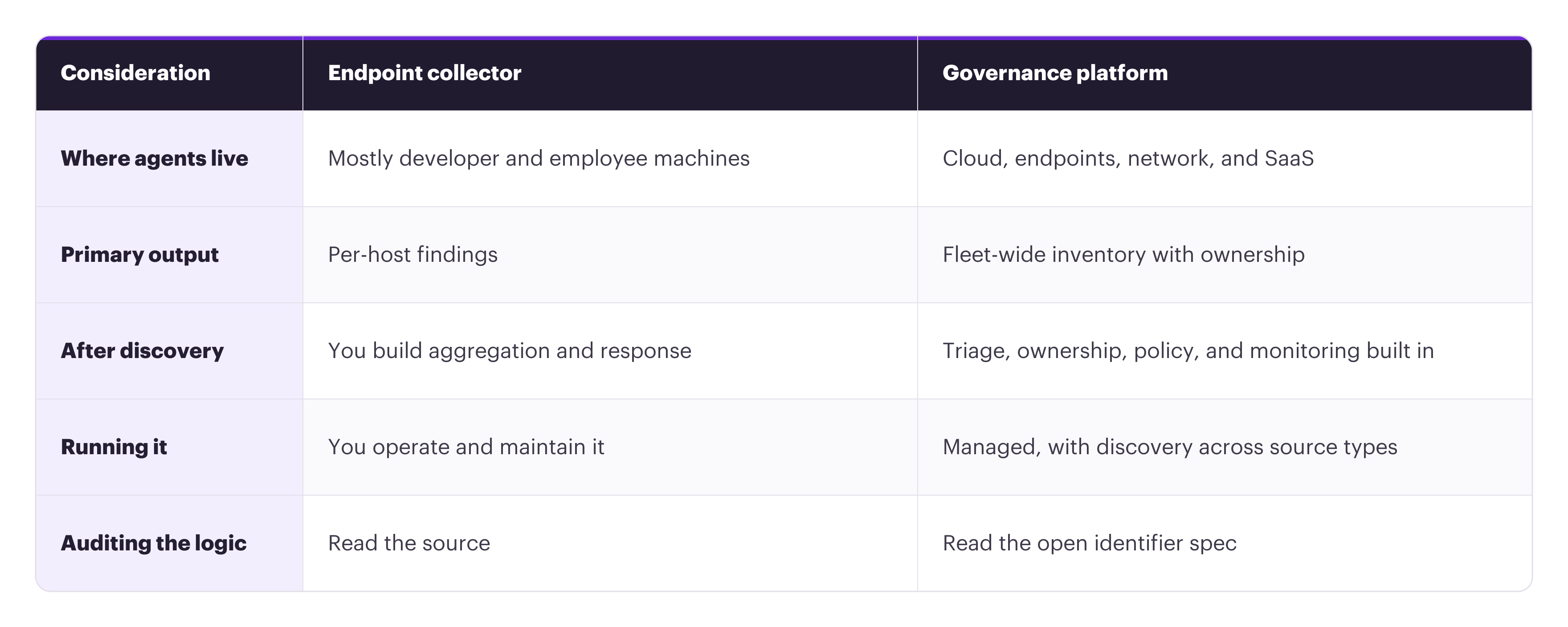
If your agent footprint is concentrated on endpoints and you want to run and audit the detection yourself, an open-source collector is a reasonable place to start. If agents are spreading across cloud platforms, SaaS tools, and networks, and you need ownership, policy, and continuous monitoring to follow discovery, a platform covers the ground a per-host collector leaves open.
Most enterprises end up needing both halves: auditable discovery you can trust, and a governance layer that turns findings into owned, monitored, policy-bound applications. The practical path is to pick an approach that shares an open catalog, so the inventory you build today still means something when your agent population grows tenfold.
Start discovering
Arthur discovers agents across cloud platforms, endpoints, networks, and your SIEM, then brings each one under a single governance framework with an owner, a risk class, and enforced policy.
- Explore the open identifier catalog at github.com/arthur-ai/ai-detection-spec.
- Run discovery yourself with Deckard at github.com/arthur-ai/deckard.
- To see fleet-wide discovery and governance in action, book a demo with an AI expert.
SHARE


